What Is Patent Claim Mapping?
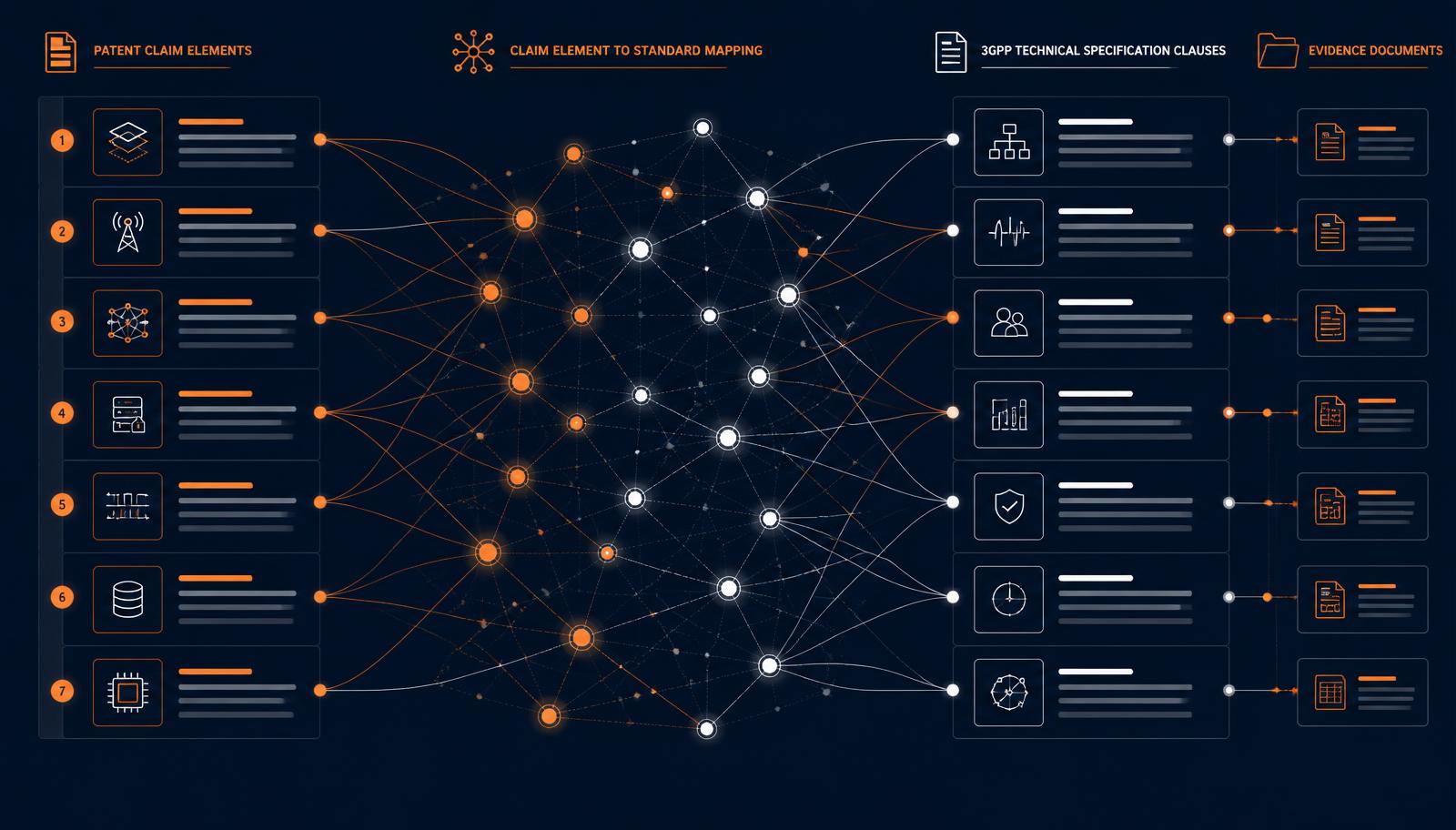
Patent claim mapping is the disciplined process of decomposing a patent claim into its individual limitations and locating, for each limitation, the exact place in an external technical document where that limitation is disclosed or required. When the external document is a technical standard, the exercise becomes standards mapping: the analyst is asking whether a compliant implementation of the standard must, as a matter of the specification's normative language, perform what the claim recites. This is why the discipline is far more demanding than keyword matching. A claim limitation such as "determining a transmission parameter based on a measurement report" may correspond to a procedure spread across a clause in one specification, a message field defined in another, and a conditional behaviour buried in a state description. Mapping is only complete when every limitation is accounted for with the same rigour.
The anatomy of a claim map
- Claim decomposition — preamble, transitional phrase and each limitation separated as a discrete testable element.
- Construction assumptions — how ambiguous terms are read, stated explicitly so the map can be reviewed.
- Standard selection — the correct specification series, release and version that governs the accused behaviour.
- Clause-level citation — specification number, clause, table or message field, plus the quoted normative text.
- Evidence tier — whether the support is mandatory ('shall'), conditional, or optional in the specification.
- Gap log — limitations with no clean normative support, flagged rather than glossed over.
Why Map Patent Claims to Technical Standards
Standards concentrate value. In telecommunications, video coding, automotive connectivity and increasingly in AI-adjacent interfaces, a single specification governs how thousands of products behave. A patent that reads on a mandatory part of that specification has a commercial reach that no ordinary product-based reading can match: it applies to every compliant implementation, regardless of vendor or design choice. Mapping patent claim to specification text is how that reach is proved rather than asserted. It is what converts a portfolio claim of essentiality into a technical position that survives scrutiny by opposing counsel, a court, or an independent essentiality evaluator.
- 01Patent claim
- 02Claim limitations
- 03Standard clause
- 04Specification detail
- 05Technical evidence
The commercial consequences follow directly from the quality of the mapping. Portfolios that are mapped carefully can be tiered — genuinely essential families separated from probable and speculative ones — which changes how a licensor prices, how a licensee negotiates, and how an acquirer values a transaction. Portfolios that are mapped loosely tend to collapse at exactly the wrong moment, when a counterparty's technical team reads the specification for themselves.
Related Hashi IP services
- Standards mapping services
Specification-level standards mapping across 3GPP, IEEE, ITU and codec families.
- SEP claim charting
Evidence-backed SEP claim charts built for licensing, litigation and essentiality review.
How Claim Mapping Supports SEP Claim Charting
It is worth separating two terms that are often used interchangeably. Claim mapping is the analysis: reading the claim, reading the standard, and deciding limitation by limitation whether the specification requires the recited behaviour. SEP claim charting is the deliverable: the structured, two-column (or three-column) document that presents the claim text against the cited standard text and any supplementary evidence, in a form a licensing counterparty or a court can evaluate. Every credible claim chart rests on a mapping that was done first; a chart produced without that analytical layer is a formatting exercise with no evidentiary weight.
| Dimension | Claim mapping | SEP claim charting |
|---|---|---|
| Purpose | Determine technical correspondence between claim and standard | Present and defend that correspondence to a third party |
| Output | Analytical worksheet, gap log, essentiality assessment | Formatted chart with claim text, cited clauses and evidence |
| Audience | Internal IP and engineering teams | Licensees, counsel, courts, evaluators |
| Failure mode | Missed limitation or wrong specification release | Unsupported citation that a counterparty can disprove |
Mapping Claims to 3GPP and Other Standard Specifications
3GPP standard mapping has its own operating rules. Specifications are versioned by release, and the behaviour a claim reads on may have been introduced, changed or removed between releases — so a map must name the release and version it relies upon. Normative force matters: language using 'shall' creates a mandatory requirement, 'should' is a recommendation, and 'may' is optional. Only mandatory behaviour supports a strong essentiality position; conditional behaviour supports a qualified one. Analysts also need to trace across the specification family, because a single claim often touches a stage-2 architecture document, a stage-3 protocol specification and a test specification that confirms how conformance is actually measured. Change Requests and meeting contributions add a further layer, showing when and why a feature entered the standard.
Practical rules for 3GPP and comparable standards
- Fix the release and version before analysis; record it on every citation.
- Prefer normative 'shall' text; mark conditional and optional support separately.
- Trace stage-2 architecture into stage-3 protocol detail rather than stopping at the overview.
- Use conformance test specifications to show that the behaviour is verified in practice.
- Where the specification permits alternatives, state which alternative the map assumes.
- Supplement with implementation evidence — chipset documentation, logs, teardown data — where the specification alone is thin.
From Technical Evidence to Standards Intelligence
A single mapped patent answers a narrow question. A mapped portfolio answers a strategic one. When mapping is captured as structured data — claim limitation, specification, clause, release, evidence tier, confidence — the results aggregate into standards intelligence: which technical areas of a standard a portfolio actually covers, where coverage is dense and where it is hollow, how coverage evolves release over release, and how one portfolio compares with a competitor's. This is where standards mapping software and AI-assisted retrieval earn their place. Semantic search over specification corpora narrows thousands of clauses to a reviewable candidate set in minutes, and structured extraction keeps citations consistent across hundreds of charts. The technical judgement — does this clause truly require this limitation — stays with experienced engineers and patent professionals.
Claim-level mapping: limitation-to-clause evidence
Family-level essentiality: tiered confidence across a patent family
Portfolio-level intelligence: coverage, gaps and competitive position
= High-quality, enforceable patent draft
Common Challenges in Claim-to-Standard Mapping
Most mapping failures are predictable. Claim terms are construed loosely, so a limitation appears satisfied when a narrower reading would defeat it. The wrong specification release is cited, and the counterparty produces a version where the language differs. Optional behaviour is presented as mandatory. Evidence stops at a heading instead of quoting the operative sentence. Or a limitation with no clean support is quietly softened rather than flagged — the single most damaging habit in the discipline, because it destroys the credibility of every other row in the chart. Discipline here is straightforward: state assumptions, cite precisely, grade confidence honestly, and keep a visible gap log.
Related reading
- SDV architectures and the coming SEP battle
How software-defined vehicles are pulling telecom SEPs into automotive licensing.
- Patent analytics services
Portfolio-level analytics that build on claim-level mapping evidence.
FAQs
Patent claim mapping is the element-by-element comparison of a patent claim against an external technical document — most often a technical standard — to determine whether each claim limitation is disclosed or required by that document. Each limitation is matched to a specific clause, message field or procedure and supported by a citable quotation, producing an auditable record of correspondence rather than a general opinion.
Talk to our standards team
Need patent claims mapped to 3GPP, IEEE or codec specifications with evidence a counterparty can verify? Our standards and SEP analysts build claim maps and charts that hold up under technical review.
Talk to our standards team