"500 disconnected patents may be less strategically valuable than 100 patents built around the technologies that actually differentiate your product."
Patent count can show the size of a portfolio. It does not necessarily show how effectively that portfolio protects the technology that creates competitive advantage. Patent depth determines how well a portfolio connects to the technology, products and competitive positions that matter most — which is why portfolio depth, not filing volume, is the more useful question for deep-tech companies, universities and R&D-intensive enterprises.
Key takeaways
- Patent count is not the same as patent strength.
- Horizontal IP creates breadth across technologies, applications and markets.
- Vertical IP strategy creates technical depth around a core innovation.
- Technology decomposition reveals where differentiated IP can exist.
- Patent intelligence connects technology, patents, products, competitors and standards.
Why Patent Count Alone Does Not Build a Competitive Moat
A company may hold hundreds of granted patents and still have weak protection around its most important technology. This happens when filings accumulate as a by-product of R&D activity rather than as the output of a deliberate patent portfolio strategy. Applications get drafted around whatever was demonstrable that quarter, families drift apart across business units, and nobody maintains a live view of which patents actually stand between a competitor and the company's differentiating technology.
Common portfolio problems
- Fragmented patent families with no connective strategy
- Duplicate or near-duplicate inventions filed by different teams
- Generic, application-focused claims that competitors can design around
- Weak connection between patents and shipped products
- Under-protected core technologies at the centre of the value proposition
- Limited competitor mapping and landscape awareness
- Limited standards intelligence in standards-driven sectors
- No clear commercialization or monetization strategy
"Patent quantity measures portfolio size. Patent depth determines strategic defensibility."
What Is Horizontal IP?
Horizontal IP is a breadth-oriented approach in which an organization develops intellectual property across multiple technologies, applications, markets or business areas. A single AI research group, for example, may file across agriculture, healthcare, computer vision, waste management, solar optimization, robotics, IoT, energy and materials — each filing framed around an application of the same underlying capability.
Typical broad, application-oriented concepts
- AI-based crop management
- Image segmentation
- Face recognition
- Waste classification
- Solar optimization
- Healthcare analytics
Horizontal IP is not a mistake. It can be strategically valuable: it explores new markets, captures multiple applications of one capability, creates discovery opportunities, supports platform expansion and generates future invention opportunities. The problem occurs when breadth becomes the only IP strategy — when a portfolio is wide across applications and shallow everywhere the technology is actually hard to reproduce.
What Is Vertical IP Strategy?
For this article, Vertical IP Strategy refers to building connected intellectual property around the technical depth of a core innovation. It is a portfolio strategy concept, not a separate legal category of intellectual property. Instead of protecting only the top-level application, the organization studies the technical stack underneath it — and files across the layers where genuine technical contribution exists.
- 01Sensing
- 02Imaging
- 03Signal processing
- 04Feature extraction
- 05ML architecture
- 06Edge inference
- 07Decision engine
- 08Automated control
Multiple technically differentiated inventions may emerge across this stack. Each layer raises its own questions of novelty: how the signal is conditioned, how features are represented, how the model is structured for a constrained device, how inference results drive a control decision under latency limits. A portfolio built across those layers is harder to design around than one that claims only the end application, because a competitor must avoid several connected technical contributions rather than a single functional description.
Horizontal vs. Vertical IP: What's the Difference?
| Horizontal IP | Vertical IP strategy |
|---|---|
| Broad technology coverage | Deep technology protection |
| Application-oriented | Technology-oriented |
| Can be fragmented | Strategically connected |
| Portfolio breadth | Portfolio depth |
| May include generic concepts | Focuses on differentiated technical contributions |
| Multiple technology areas | Connected technical layers |
| Discovery-oriented | Defensibility-oriented |
| Filing-driven when unmanaged | Strategy-driven |
The goal is not to eliminate horizontal IP. Use horizontal innovation as the discovery layer and vertical IP strategy as the defensibility layer.
The Hashi 7-Layer IP Strategy Model
Hashi's 7-Layer IP Strategy Model is our internal framework for examining where protectable technical contribution sits within an innovation. It is a Hashi strategy model, not an established industry or legal framework. Each layer is a place to ask whether a differentiated invention exists — and whether the current portfolio reaches it.
The seven layers
- Core technology — the fundamental technical principle or innovation.
- Architecture — how the technology is structured and organized.
- Technical mechanisms — the specific mechanisms that create technical differentiation.
- Implementation — how the innovation is implemented in software, hardware, firmware, processes or systems.
- System integration — how components interact within a larger system.
- Commercial application — how the technology creates value in a real-world product or use case.
- Standards & ecosystem — where the technology intersects with technical standards, interoperability or ecosystem requirements.
From Generic Patent Filing to Differentiated IP
Take a generic concept such as "AI-based image segmentation". As a claim, it describes an outcome that a large body of prior art already covers. The differentiated IP sits in the answers to the deeper technical questions — and each answer is a candidate invention that a well-run disclosure process should surface.
Questions that surface differentiated inventions
- How is the image acquired?
- What preprocessing occurs?
- How are features extracted?
- What inference architecture is used?
- What novel computation occurs?
- How is edge processing performed?
- Is hardware acceleration involved?
- What technical improvement is achieved?
- How do components interact?
- What measurable technical benefit results?
The opportunity is not simply to patent the application. It is to identify the technical contributions that make the application work.
Where this connects to drafting and filing
- Patent drafting services
Technical drafting that claims the mechanism, not only the outcome.
- Patent filing services
Provisional, complete, PCT and national-phase filing built around a family strategy.
Technology Decomposition: Finding the IP Beneath the Product
What decomposition helps identify
- Core inventions at the centre of the technology
- Supporting inventions that reinforce the core
- Differentiated mechanisms competitors have not claimed
- Implementation innovations specific to real deployment constraints
- Integration inventions arising from how components interact
- Future patent opportunities as the technology roadmap advances
- 01Product
- 02System
- 03Architecture
- 04Components
- 05Mechanisms
- 06Algorithms / processes
- 07Implementation
Explore patent intelligence
See how technology decomposition, prior-art intelligence and portfolio analytics come together in our patent analytics practice.
Explore patent intelligencePatent Landscape + Prior-Art Intelligence
Mature IP programmes shift the operating question from "Can we file a patent?" to "Where can we build IP around technology competitors do not already control?" That is a landscape question, and it is answered with evidence rather than intuition: prior art, patent landscapes, competitor portfolios, white spaces, crowded technology areas, patent families, expiring rights, emerging players and technology trends. Read together, these signals show which technical layers are still open and which are already dense with third-party filings.
Intelligence services referenced here
- AI prior art search
Semantic, AI-assisted searching validated by patent professionals.
- Freedom to operate search
Risk-oriented clearance analysis before commercial launch.
How to Build a Strong Vertical IP Portfolio
A vertical portfolio is built deliberately, in a sequence that starts with technology rather than paperwork. The seven steps below describe how Hashi structures that work with technology teams.
Seven-step roadmap
- Technology discovery — map research, products, prototypes, algorithms, architecture, R&D activity and publications.
- Technology decomposition — product → system → architecture → components → mechanisms → algorithms → implementation.
- Generic vs. differentiated IP analysis — classify inventions as generic, incremental, differentiated, deep-tech, platform technology or strategic technology.
- Patent landscape & prior-art intelligence — identify competitor filings, white spaces, crowded areas, relevant prior art and expiring rights.
- Patent family strategy — connect core invention → architecture → mechanism → implementation → integration → commercial application.
- Connect IP with products and markets — patent-to-product mapping, competitive mapping, licensing analysis, technology transfer and spin-off opportunities.
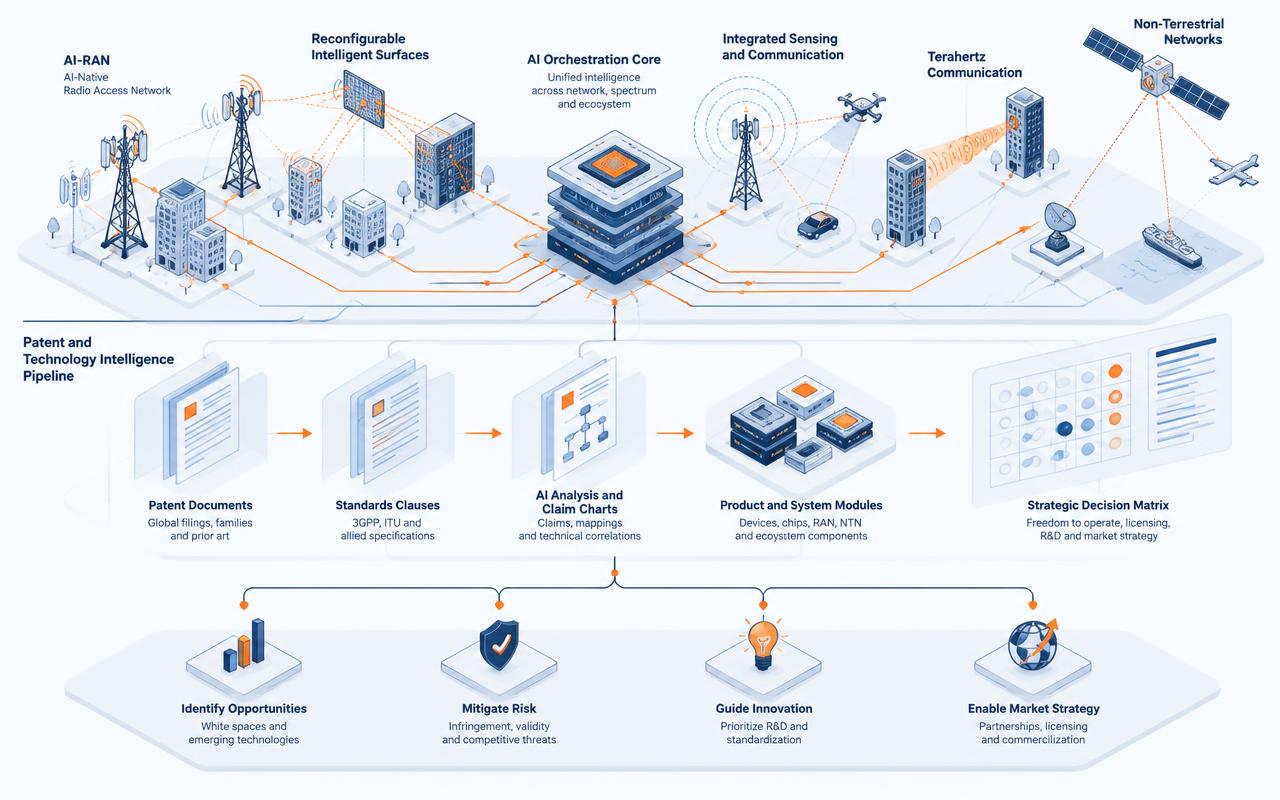
- Standards & SEP opportunities — for relevant technologies, trace technology → standard → specification → patent → claim across 5G, 6G, wireless, IoT, automotive, video and network technologies.
Why IP Depth Matters for Deep-Tech Companies
Deep-tech businesses operate with longer technology development cycles and higher R&D investment than software-only companies, and their competitive position rests on technical differentiation that takes years to reproduce. That shapes IP requirements in practical ways: investor diligence increasingly examines what is actually claimed rather than how many applications exist; strategic partnerships and licensing conversations turn on whether the IP maps to identifiable technology; and product defensibility depends on whether the protected subject matter is the part competitors would need to copy. Deep-tech companies increasingly require longer technical and IP diligence cycles — depth is what makes those cycles survivable.
What the Global Patent Landscape Is Signaling
Global filing activity remains concentrated in technology-intensive fields. WIPO's World Intellectual Property Indicators reports computer technology, digital communication and electrical machinery among the largest fields of published patent applications, and WIPO has separately reported a sharp acceleration in generative-AI patent families in recent years. The direction of travel matters more than any single figure: the technical areas where deep-tech companies compete are also the areas where third-party filing density is rising fastest, which shortens the window in which a white space stays open.
India's Deep-Tech IP Opportunity
Indian technology organizations are producing patentable work across AI, semiconductors, EV and batteries, robotics, healthcare technology, aerospace, SaaS and university-led deep-tech R&D. The Office of the Controller General of Patents, Designs and Trade Marks reports sustained growth in patent applications and grants in its annual reports, with a rising share of filings originating from Indian applicants. The strategic gap is rarely willingness to file — it is the connection between research output and portfolio design.
- 01Research
- 02Invention
- 03Patent
- 04Portfolio
- 05Product
- 06Commercialization
Why Hyderabad's Deep-Tech Ecosystem Needs Technology-Centered IP Strategy
Hyderabad's technology base spans AI, SaaS, semiconductors, aerospace, robotics, EV, healthcare, life sciences and advanced engineering — sectors where competitive advantage is technical and where a purely application-level filing habit leaves the differentiating layers exposed. For organizations building here, a technology-centered IP strategy means decomposing the stack before filing, checking landscape density layer by layer, and connecting each family to a product or licensing objective.
- Patent filing services in Hyderabad
Local drafting, filing and prosecution support for Hyderabad deep-tech teams.
Patent-to-Product Mapping: Connecting IP to Commercial Reality
What mapping helps organizations understand
- Which patents protect which products
- Which technologies are strategically important
- Competitive IP positioning across a technology area
- Licensing opportunities the portfolio can support
- Potential white spaces worth filing into
- Portfolio gaps around core technology
- 01Patent
- 02Technology
- 03Product
- 04Competitor
- 05Market
Explore patent-to-product mapping
Connect each patent family to the technology, product and competitive position it is meant to protect.
Explore patent-to-product mappingIs your patent portfolio actually defensible?
Request the Hashi Patent Portfolio Depth Checklist — core technology identified, technology layers mapped, generic vs. differentiated inventions classified, prior art reviewed, competitor landscape analyzed, patent families connected, products mapped to patents, and standards opportunities assessed. Tell us where to send it and a Hashi analyst will follow up.
Standards, SEP and Technology Strategy
In standards-driven sectors, technology strategy and IP strategy converge on a single chain: technology → standard → specification → patent → claim. Where an organization contributes technology that ends up reflected in a specification, the portfolio's relevance extends to every compliant implementation. This is directly relevant to 5G, 6G, IoT, automotive, video, wireless and networking. The analytical work — standards mapping, SEP claim charting, patent landscape and competitive intelligence — establishes technical correspondence and evidence; it does not, on its own, produce legal conclusions about essentiality or infringement.
Standards intelligence services
- Standards mapping
Specification-level mapping across 3GPP, IEEE, ITU and codec families.
- SEP claim charting
Evidence-backed charts for licensing, negotiation and essentiality review.
- SEP analysis
Portfolio-level standards-essentiality intelligence.
Why Universities and Enterprises Need IP Depth
Universities
- Research → publication → invention → patent → technology transfer → licensing or spin-off
- Research commercialization pathways
- Technology transfer readiness
- Patent portfolio quality over count
- Industry partnerships and sponsored research
- Licensing opportunities built on depth
Enterprises
- R&D → technology → patent → product → competitive position
- Duplicate inventions across teams
- Overlapping and drifting patent families
- Under-protected core technology
- Weak product-to-patent relationships
- Business-unit fragmentation of IP
The Hashi IP Intelligence Framework
This is how Hashi connects technology intelligence with IP strategy. Each stage feeds the next, so portfolio decisions are made against technical and competitive evidence rather than filing habit. Our role is intelligence, analysis and strategic support — not the provision of legal opinions.
- 01Technology intelligence
- 02Technology decomposition
- 03AI prior art search
- 04Patent search & analytics
- 05Patent landscape
- 06Generic vs. differentiated IP assessment
- 07Patent portfolio strategy
- 08Patent-to-product mapping
- 09Standards mapping
- 10SEP claim charting
- 11IP commercialization & monetization intelligence
IP Commercialization Starts With Portfolio Quality
Commercialization conversations usually open with "Who can we license this to?" A more productive starting point is "Why would another company need this IP?" That question forces an honest assessment of whether the portfolio covers technology someone else must practise. Licensing, technology transfer, spin-offs, strategic partnerships, product protection, standards-related opportunities and portfolio monetization all depend on the same underlying variable: portfolio quality, expressed as depth around technology that matters.
- Patent analytics services
Portfolio analytics, competitive intelligence and monetization insight.
- IP management services
Portfolio governance, mapping and lifecycle strategy.
Frequently asked questions
Horizontal IP builds breadth across multiple technologies, applications or markets. Vertical IP strategy builds connected depth across the technical layers of one core innovation. Breadth supports discovery and market exploration; depth supports defensibility. Most strong portfolios use horizontal innovation as the discovery layer and vertical IP strategy as the defensibility layer rather than choosing one exclusively.
Request an IP portfolio assessment
A large patent portfolio does not automatically create a strong competitive position. Hashi IP Solutions helps organizations connect technology intelligence, prior-art analysis, patent landscapes, portfolio strategy, product mapping and standards intelligence to build more strategically aligned IP portfolios.
Request an IP portfolio assessment