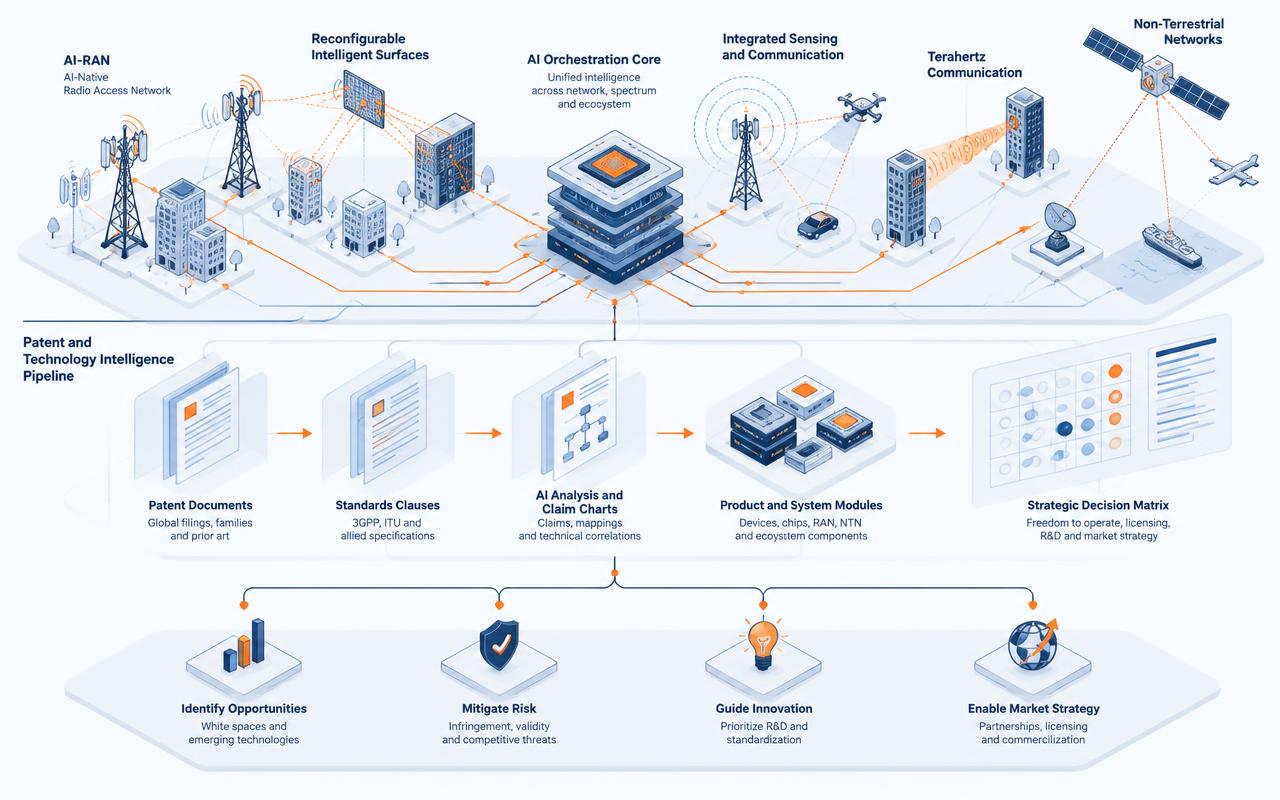
A patent portfolio is not the same as an IP position
A startup can have 5 patents, 20 patents or 100 patents — and still lack a meaningful IP strategy. Filing volume is easy to measure. Strategic coverage is not. The difference shows up when an investor, an acquirer or a competitor asks what your patents actually protect.
The questions an IP strategy answers
- What technology creates real differentiation for the business?
- Which product features depend on that technology?
- What should be patented, and what should stay confidential?
- Who else is protecting similar technology, and how aggressively?
- Can the company commercialize safely in its target markets?
- Where are competitors filing, and where is white space opening?
- Which assets create commercial leverage in funding or partnerships?
- Where should the portfolio expand over the next 24 months?
"The goal is not to build the largest patent portfolio. The goal is to build the right IP position for the business."
Why patent strategy is not the same as IP strategy
Patent strategy asks execution questions: what to file, when, where, and how claims should be structured. IP strategy asks business questions first, then decides which protection mechanism serves them. Both matter, but only one of them starts from the company's commercial objectives.
Patent strategy
- What should we patent?
- When should we file?
- Where should we file?
- How should claims be structured?
- How should the portfolio be maintained?
IP strategy
- What technology creates business value?
- What should we protect, and what stays confidential?
- What do competitors own?
- Where are FTO risks?
- Which products need protection?
- Where are white-space opportunities?
- Which IP can create commercial leverage?
Where they meet
- Claim scope tied to product roadmap
- Filing geography tied to market plans
- Budget tied to asset importance
- Portfolio review tied to strategy review
Why startups need an IP strategy earlier than they think
Early decisions are cheap to make and expensive to reverse. A disclosure made before filing, a core technique published in a paper, or a product launched without freedom-to-operate review can permanently narrow the options available later. An IP strategy front-loads those decisions while the cost of changing course is still low.
Six reasons IP strategy matters for technology startups
- 01 — Protect differentiation: identify the technology that actually separates you from alternatives.
- 02 — Support product strategy: align protection with the features you plan to ship and sell.
- 03 — Reduce IP risk: surface third-party rights before engineering commitments harden.
- 04 — Understand competitors: know who is filing, where, and in which technical directions.
- 05 — Strengthen investor readiness: answer diligence questions with evidence, not filing counts.
- 06 — Create future commercial value: build assets usable in licensing, partnerships and exits.
The 7-layer startup IP strategy framework
This is the model Hashi uses with technology-driven startups. Each layer answers one question, and each layer constrains the one below it. Read top-down, it prevents filing decisions that are disconnected from the business; read bottom-up, it explains why a specific asset matters.
- 0101 BUSINESS — What business outcome are we protecting?
- 0202 TECHNOLOGY — What technology creates differentiation?
- 0303 PRODUCT — Which product features depend on that technology?
- 0404 IP — What should be patented, held as trade secret, or otherwise controlled?
- 0505 COMPETITION — Who else is protecting similar technology?
- 0606 FTO — Can we build, launch and scale without unacceptable IP risk?
- 0707 VALUE — Can IP strengthen valuation, licensing, partnerships or market position?
Build Your IP Strategy
Is your IP strategy aligned with your business strategy? Your technology roadmap, products, competitors and IP portfolio should not operate in separate silos.
Build Your IP StrategyWhat should a startup actually protect?
Depending on the technology and business circumstances, different mechanisms protect different things. Patents protect disclosed technical solutions. Trade secrets protect know-how that competitors cannot easily observe. Copyright covers expression such as source code. Trademarks protect market identity, and design rights protect appearance. Defensive publication can block others from patenting something you do not want to own.
| Mechanism | Best suited to | Strategic trade-off |
|---|---|---|
| Patents | Technical solutions visible in a product or inferable from it | Exclusivity in exchange for public disclosure |
| Trade secrets | Process know-how, training recipes, tuning parameters, internal tooling | No disclosure, but no protection against independent development |
| Copyright | Source code, documentation, datasets and model artefacts as expression | Automatic and cheap, but protects expression rather than function |
| Trademarks | Product and company identity in target markets | Commercial protection, not technical protection |
| Design rights | Interface and product appearance | Narrow scope, fast to obtain |
| Defensive publication | Improvements you want available but unpatentable by others | Blocks competitors, gives you no exclusivity |
This overview is general in nature. Protection decisions should be reviewed against your specific technology, jurisdictions and commercial plans.
Should we patent this innovation? A practical decision path
Most startups do not need a longer filing list — they need a repeatable way to decide. Run each candidate innovation through the same sequence, and record the reasoning so future decisions stay consistent.
- 01Is it technically differentiated?
- 02Does it support an important product or roadmap item?
- 03Would disclosure be acceptable?
- 04Could competitors benefit from using it?
- 05Choose: patent, trade secret, or another mechanism
- 06Where should protection exist geographically?
- 07What is the competitive landscape around it?
- 08What is the potential business value if protected?
Your patent should connect to what you actually build
Patent-to-product mapping is the discipline of tracing each asset down to the commercial capability it protects. Without it, portfolio reviews become filing-count exercises, and renewal budgets get spent on assets no product depends on.
- 01Patent
- 02Claim
- 03Technology
- 04Product feature
- 05Product
- 06Market
- 07Business value
"A patent portfolio becomes strategically meaningful when decision-makers can understand which IP protects which technologies, products and commercial capabilities."
Explore patent-to-product mapping
- Patent Analytics
Portfolio assessment, claim-to-product mapping and technology landscape analysis.
- IP Management
Portfolio governance, docketing and lifecycle decisions tied to product plans.
Your IP strategy cannot be built in isolation
Competitive IP intelligence turns patent data into a view of where the technology field is moving. It answers questions your internal roadmap cannot: which companies are entering your space, which technical directions are getting crowded, and which areas remain genuinely open.
Questions competitive patent intelligence should answer
- Who owns patents similar to our core technology?
- Who is filing aggressively, and at what rate?
- Which technologies are competitors choosing to protect?
- Which new companies are entering the market?
- Where is IP ownership concentrated?
- Where are the white spaces?
- Which technical areas are becoming crowded?
- Where are competitors expanding geographically?
Your portfolio
Competitor portfolios
Technology landscape
Market evolution
Strategic IP decisions
= High-quality, enforceable patent draft
Freedom to operate belongs in the product roadmap
FTO analysis is often treated as a pre-launch checkbox. By then, architecture is fixed, contracts are signed and design-around options are limited. Intelligence-led teams move the same question upstream, where a small design change costs a sprint instead of a release cycle.
Traditional approach
- Product development
- Product ready
- FTO search
- Risk discovered late
Intelligence-led approach
- Technology concept
- Competitive landscape review
- FTO analysis
- Design-around opportunities
- Product development
- Continuous monitoring
What changes
- Risk is a design input, not a launch surprise
- Engineering keeps optionality
- Legal spend shifts from firefighting to planning
"The earlier IP risk enters the product decision process, the more options the company has to respond."
Explore FTO & IP intelligence
- Prior Art & FTO Search
Freedom-to-operate, invalidity and prior-art analysis for product decisions.
- Patent Search Services
Patentability, landscape and clearance searches across global databases.
Talk to an IP Intelligence Expert
Know where you stand before your competitors do. A structured competitive and FTO review shows you the landscape your roadmap is being built into.
Talk to an IP Intelligence ExpertBuilding the startup IP moat
A moat is not created by owning patents. It is created when protection, product relevance and competitive position reinforce each other. Layered correctly, a modest portfolio can be more defensible than a large but unfocused one.
Defensibility depends on more than ownership
- Claim scope — is the claim broad enough to cover realistic alternatives?
- Product relevance — does a shipping product depend on the claimed feature?
- Competitor landscape — how densely is the area already patented?
- Enforcement position — is infringement detectable and provable?
- Technology differentiation — is the advantage technical or merely commercial?
- Market importance — does the protected feature drive buying decisions?
- FTO — can you practise your own invention without third-party conflict?
- Portfolio breadth — is the coverage a single asset or a family?
- 01Core IP — protects the primary differentiator
- 02Supporting IP — protects implementations and improvements
- 03Defensive IP — preserves your own freedom to operate
- 04Blocking IP — constrains obvious competitor design-arounds
- 05Ecosystem & standards intelligence — tracks where the field is heading
- 06Result: defensible competitive advantage
IP strategy for AI startups
AI companies face a protection problem that traditional software firms do not: value is spread across architecture, data pipelines, training methodology, inference behaviour and deployment infrastructure — and much of it is invisible from outside the product. The strategic task is deciding which layer to disclose and which to keep closed.
| AI value layer | Typical protection posture | Why |
|---|---|---|
| Model architecture and novel components | Patent | Technically differentiated and often inferable from behaviour or publications |
| Training techniques, data curation and tuning recipes | Trade secret | High value, hard for outsiders to detect, easy to erode by disclosure |
| Inference optimisation and serving efficiency | Patent or trade secret | Depends on whether gains are measurable externally |
| Retrieval systems and agent orchestration | Patent | Increasingly claimed; crowding is rising fast in this area |
| Hardware acceleration and AI infrastructure | Patent | Detectable in silicon, systems and product documentation |
| Application-layer workflows and UX | Copyright, design rights, selective patents | Expression and appearance matter as much as function |
AI-focused portfolios should also plan for continuous monitoring — this field's landscape shifts within quarters, not years.
Executing an AI-native filing programme
- AI patent drafting services for startups
How AI-assisted drafting lowers cost per application without losing quality.
- Agentic AI for patent drafting
The emerging AI-native workflow behind modern IP execution.
IP strategy for startups in India
For technology-driven startups in Hyderabad and across India, IP strategy increasingly needs to connect patent protection with product development, market expansion, competitive intelligence and long-term business strategy. Indian deep tech, semiconductor, EV and AI companies now sell into global markets from day one, which means filing decisions taken locally have international consequences.
What an India-based startup should plan for
- Early IP planning before disclosures at demo days, accelerators and conferences.
- A considered provisional-to-complete path that supports the claims you will need.
- International expansion through PCT and direct filings aligned with target markets.
- Investor diligence readiness — assignment chains, inventor records and claim-to-product mapping.
- Competitive intelligence covering both Indian and foreign filings in your field.
- FTO review before commercial launch in each key jurisdiction.
- Cost optimisation through startup fee reductions and reimbursement support.
Execution and cost guides
- how to file a patent in India
Process, documents, costs and timelines when you move from strategy to execution.
- DPIIT startup patent benefits
Government incentives, fee reductions and expedited examination for recognised startups.
- patent reimbursement schemes in India
State and central schemes that reduce the net cost of a filing programme.
- Patent filing services in Hyderabad
Local IP intelligence and patent strategy support for Hyderabad-based technology companies.
When should a startup build an IP strategy?
The honest answer is earlier than most founders expect, but the work should scale with the stage. Each stage has one primary IP question worth answering well.
| Stage | Primary IP question | Strategic action |
|---|---|---|
| Idea / research | What is genuinely novel here? | Set confidentiality discipline; run a light landscape scan before publishing |
| MVP | Which component creates the differentiation? | Capture invention records; file priority on the core technique |
| Product development | What are we committing to technically? | Early FTO review and design-around options before architecture locks in |
| Pre-funding | Can we evidence our IP position? | Portfolio assessment, claim-to-product mapping, clean assignment chain |
| Market launch | Can we sell safely in these markets? | Jurisdiction-specific FTO and trademark clearance |
| Scale | Is coverage keeping pace with the roadmap? | Continuation strategy, competitor monitoring, white-space filings |
| Growth / M&A | What is this portfolio worth to a buyer? | Valuation-focused portfolio review, licensing and monetisation options |
Executive decision matrix: business question to strategic output
| Business question | IP intelligence needed | Strategic output |
|---|---|---|
| What should we protect? | Technology analysis | Protection strategy |
| What do competitors own? | Competitive patent intelligence | Competitive position |
| Can we launch safely? | FTO analysis | Risk strategy |
| Which products need protection? | Patent-to-product mapping | Product protection plan |
| Where should we file? | Market and geographic analysis | Filing strategy |
| Where are opportunities? | White-space analysis | R&D and IP opportunities |
| Which assets matter? | Portfolio assessment | Portfolio priorities |
| Can IP create revenue? | Monetization analysis | Commercial opportunities |
From patent portfolio to IP intelligence
Documents become a portfolio when they are organised. A portfolio becomes analytics when it is measured. Analytics becomes intelligence when it is connected to technology, products, competitors, standards and markets — and intelligence becomes business value when it changes a decision.
- 01Patent documents
- 02Patent portfolio
- 03Patent analytics
- 04IP intelligence
- 05Business intelligence
From managing IP to understanding IP
Hashi IP Solutions is an AI-native intellectual property intelligence company helping technology-driven organizations understand, protect, analyze and maximize the value of their innovations. We work at the intersection of patent expertise, technology depth and analytics — so IP decisions are made with the same rigour as engineering and product decisions.
Capabilities that support startup IP strategy
- Patent strategy and portfolio planning
- Patent and prior-art search
- Patent analytics and landscape analysis
- IP portfolio assessment and claim-to-product mapping
- Competitive IP intelligence and monitoring
- Freedom-to-operate support
- Standards and SEP intelligence
- IP management and monetization support
Discuss Your IP Strategy
Tell us about your technology, stage and IP challenge. A Hashi IP strategist will review your position and respond with practical next steps — confidential, no obligation.
Frequently asked questions
An IP strategy for startups is a structured approach to identifying, protecting, managing, monitoring and commercializing intellectual property in alignment with the company's technology, products, markets, competitors and business objectives. It defines what to protect and why, not just what to file.
Continue your IP intelligence journey
- How to File a Patent in India
Executing the filing side of your strategy: process, documents, cost, timeline.
- DPIIT Startup Patent Benefits
Recognition, fee reductions and expedited examination for Indian startups.
- Patent Reimbursement Schemes in India
Reduce the net cost of a multi-year filing programme.
- AI Patent Drafting Services for Startups
AI-assisted execution once strategy sets the direction.
Don't just build a patent portfolio. Build an IP advantage.
Your technology is evolving. Your competitors are evolving. Your IP strategy should evolve with them. Hashi IP Solutions brings AI-powered intellectual property intelligence to the decisions that shape your portfolio — what to protect, where risk sits, and where the next advantage will come from.
Build Your IP Strategy
Talk to Hashi IP Solutions about a structured IP strategy review for your startup.
Build Your IP Strategy