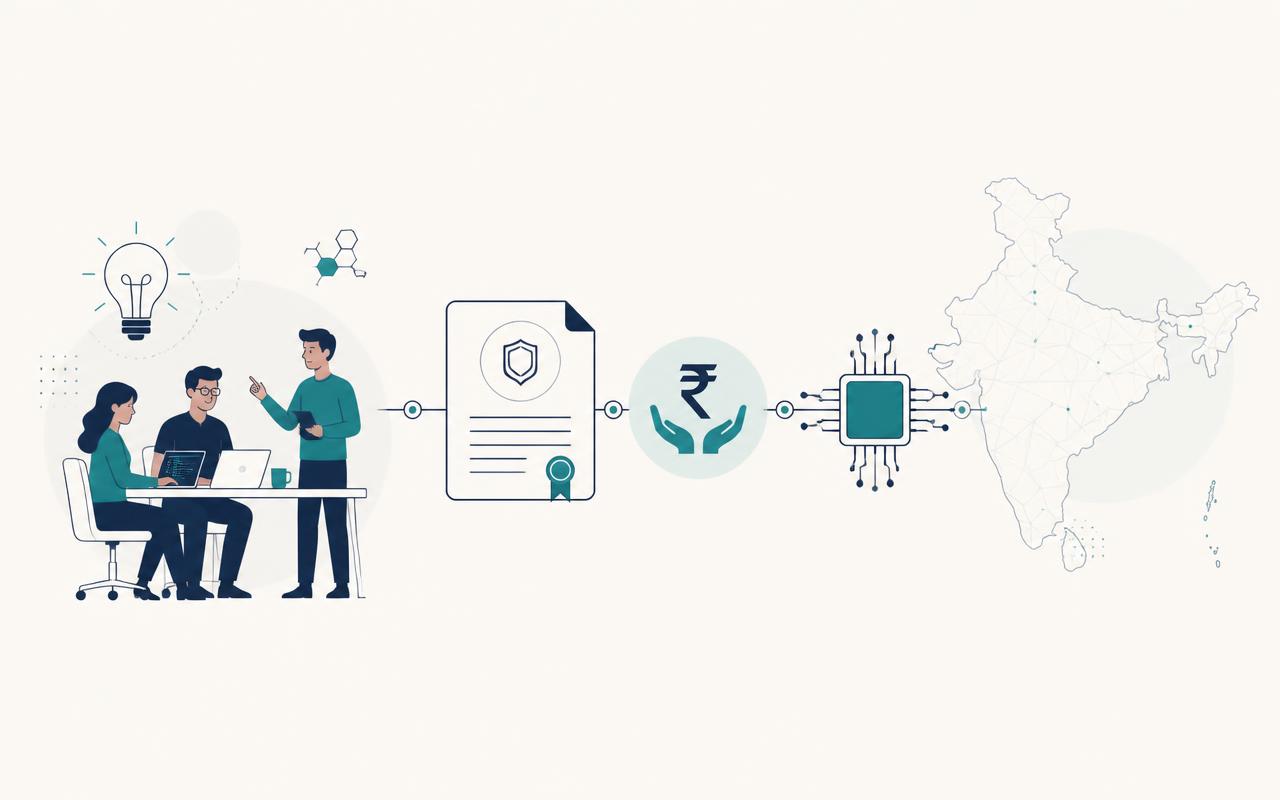
Can Indian startups and MSMEs protect their inventions without carrying the entire cost of patent searching, drafting and filing? In many cases, yes. The Government of India and several state governments have introduced intellectual property incentives and reimbursement schemes designed to encourage startups, MSMEs and innovators to protect their inventions. Depending on the applicant's eligibility, location, type of intellectual property, eligible expenditure and applicable reimbursement ceiling, these programs can substantially reduce the effective cost of patent protection.
Key Takeaways
- Eligible Indian MSMEs may receive patent-related financial assistance under the MSME Innovative IPR component.
- The MSME Innovative programme lists maximum assistance of ₹1 lakh for domestic patents and ₹5 lakh for foreign patents.
- State-level programmes can provide additional opportunities for eligible startups.
- Goa, Kerala and Karnataka publish significant patent-related incentives.
- Professional and legal expenses may be eligible under some schemes, but eligibility varies.
- Reimbursement ceilings are maximum limits, not guaranteed payouts.
- Startups should investigate applicable schemes before incurring significant patent-related expenses.
- Patent quality should not be sacrificed simply to reduce filing costs.
Talk to our team
- Discuss your patent strategy
A short call to map your invention, timing and the schemes that may apply to you.
- Explore patent services
Patent search, drafting, filing, prosecution and analytics under one roof.
What is a patent reimbursement scheme in India?
A patent reimbursement scheme is a government incentive that refunds part of the money an applicant spends on protecting an invention. Instead of paying a grant upfront, the government reimburses eligible expenditure — typically official patent office fees and, under some schemes, professional charges for patentability search, drafting, filing and prosecution — after the expense is incurred and documented. The purpose is to lower the barrier to intellectual property ownership for Indian innovators, particularly recognised startups and Udyam-registered MSMEs whose cash position makes multi-jurisdiction filing difficult.
Eligible applicants generally include Udyam-registered micro, small and medium enterprises, DPIIT-recognised startups, and in state programmes, entities registered or operating within that state. Reimbursement is never automatic: each scheme sets its own application window, claim format, supporting-document list, ceiling per application and cap per entity. An expense incurred before eligibility is established, or outside the scheme's defined heads of expenditure, is usually not reimbursable.
Related reading on Hashi
- DPIIT startup patent benefits: the complete founder's guide
The 80% fee rebate, SIPP facilitator support and expedited examination explained end to end.
- Patent filing for startups in India
Costs, timelines and a practical filing roadmap for early-stage companies.
How much patent reimbursement can startups and MSMEs get in India?
Published ceilings vary by scheme and by whether the filing is domestic or foreign. The table below summarises the maximum limits announced under widely referenced central and state programmes. Treat every figure as an upper limit subject to eligibility, eligible expenditure, documentation and scheme-specific conditions — not as a guaranteed payout.
| Scheme | Domestic patent | Foreign / international patent |
|---|---|---|
| MSME Innovative – IPR | Up to ₹1 lakh | Up to ₹5 lakh |
| Goa Startup IPR Reimbursement | Up to ₹2 lakh | Up to ₹5 lakh |
| Kerala Startup Mission | Up to ₹2 lakh | Up to ₹10 lakh |
| Karnataka Startup Policy | Up to ₹2 lakh | Up to ₹10 lakh |
These are maximum published limits and are subject to eligibility, eligible expenditure, documentation and scheme-specific conditions. Verify current figures with the official source before relying on them.
Official source: MSME Innovative IPROfficial source: Goa Startup Policy 2025Official source: Kerala Startup Mission
MSME Innovative Scheme: patent reimbursement for Indian MSMEs
The MSME Innovative scheme consolidates incubation, design and intellectual property support for Udyam-registered enterprises. Its IPR component provides financial assistance towards registering intellectual property — including patents, trademarks, geographical indications and designs — and supports IP Facilitation Centres that guide MSMEs through the process. The published ceiling is up to ₹1 lakh for a domestic patent and up to ₹5 lakh for a foreign patent, applied per granted or filed application as defined in the scheme guidelines.
What MSMEs should confirm before claiming
- Valid Udyam registration at the time the expenditure is incurred.
- The IP category claimed is covered by the IPR component.
- The expenditure head — official fees, attorney charges, search reports — is listed as eligible.
- Claim documents: invoices, filing receipts, application numbers and bank details.
- The per-entity and per-application caps have not already been exhausted.
- The application is submitted within the scheme's stated timeline.
Official sources for this section
Check your patent filing strategy
Before you spend on filing, we will tell you whether the invention is worth patenting, where to file first, and which costs are likely to be reimbursable.
Check your patent filing strategyDoes the MSME scheme cover patent search and drafting costs?
Partly — and conditionally. The MSME Innovative IPR component supports activities such as patentability searches, technology gap analysis and IP advisory, and funds IP Facilitation Centres that deliver these services to MSMEs. That is not the same as an open promise to reimburse every private invoice from every patent professional. Scheme-supported activities are usually delivered or validated through recognised channels, and reimbursement of professional charges depends on the expenditure head and documentation the guidelines define.
Goa patent reimbursement schemes
The Goa Startup Policy 2025 continues Goa's practice of reimbursing intellectual property expenditure for registered startups. The policy provides support for national IP registration — including patents, and typically trademarks, designs and copyrights — as well as a higher ceiling for international IP filings, reflecting the larger official and attorney costs involved. Published ceilings are commonly cited as up to ₹2 lakh for national IP and up to ₹5 lakh for international IP, subject to registration with the state startup authority, the expenditure heads listed in the policy and the claim procedure notified by the Department of Information Technology.
Kerala patent reimbursement
Kerala Startup Mission operates one of India's most active state startup ecosystems and runs patent support for startups registered with it. Support is generally structured as reimbursement of expenditure for Indian patent filings, with a substantially higher ceiling for foreign filings — widely published as up to ₹2 lakh and up to ₹10 lakh respectively. Eligibility typically requires a valid Kerala Startup Mission registration, a Kerala-registered entity, and the filing to be in the name of the startup rather than an individual founder.
Kerala source
Karnataka patent reimbursement
Karnataka's startup policy, administered through the Karnataka Startup Cell, reimburses IP costs for eligible startups registered in the state. The policy distinguishes between Indian and international patents, with commonly published ceilings of up to ₹2 lakh and up to ₹10 lakh, and — unlike some schemes — expressly contemplates legal and drafting expenses within eligible expenditure where the guidelines allow. Reimbursement is normally released after grant or after defined filing milestones, so cash-flow planning matters.
Karnataka source
Can patent protection really have "zero effective cost"?
Only when your eligible expenditure is at or below the applicable ceiling and the claim is approved. The arithmetic is simple, and it is worth doing before you commit to a filing plan.
Scenario A — fully covered
- ₹1,00,000 eligible expense
- minus ₹1,00,000 reimbursement
- = ₹0 effective reimbursable cost
Scenario B — partly covered
- ₹2,50,000 expense
- minus ₹1,00,000 reimbursement
- = ₹1,50,000 unreimbursed cost
What this means
- Ceilings cap the refund, not your spend
- Ineligible heads stay on your books
- Timing gaps affect working capital
- "Zero cost" is conditional, never automatic
The real question: should you file a patent at all?
A reimbursement cheque does not make a weak patent valuable. Before cost enters the conversation, test the invention against novelty, inventive step and industrial applicability, then against commercial reality: does the claim cover something a competitor would need to copy, in a market where you will actually operate? Filings that fail this test consume management attention and renewal fees for twenty years while protecting nothing. Filings that pass it become assets investors, acquirers and licensees price. Hashi works as a strategic IP partner on exactly this decision — including the recommendation not to file when the evidence does not support it.
Where this connects
- Patent analytics and IP intelligence
Landscape, whitespace and competitor portfolio analysis to test commercial relevance.
- SEP analysis
For standards-driven technologies where claim mapping determines value.
Patent search: the first investment in a strong patent
A patentability and prior-art search is the cheapest way to avoid an expensive mistake. A rigorous search surfaces the closest prior art, tests novelty and inventive step, maps competitor filings and patent families, exposes technology gaps you can claim into, and isolates the differentiating features that should anchor your independent claims. Done before drafting, it shapes claim scope; done after filing, it only tells you what went wrong.
Explore patent search services
Patent drafting: protect the technology, not just the idea
Drafting decides what you actually own. Strong specifications build a layered claim set — broad independent claims supported by dependent claims that fall back to defensible positions — and disclose multiple embodiments and alternative implementations so future products remain covered. System and method claims should be paired where the invention supports both, and computer-implemented inventions need careful structuring around technical effect. Drawings are not decoration: they anchor support for claim language during examination.
Explore patent drafting services
Patent filing in India: what startups need to know
Indian practice allows a provisional application to establish an early priority date, followed by a complete specification within 12 months. Filing is done online through the Indian Patent Office's e-filing system using the prescribed forms, with fee concessions available to startups and small entities. Examination is not automatic — a request for examination must be filed, and startups may be eligible for expedited examination. Missing the 12-month complete-specification deadline forfeits the priority date, which is the single most common and most expensive mistake founders make.
Indian Patent Office sources
Filing support
India first or international patent filing?
Choose jurisdictions by where value is captured, not by prestige. Map your target markets, the countries where competitors manufacture and sell, your own manufacturing footprint, likely licensing counterparties and investor expectations. Indian residents must respect foreign-filing requirements before filing abroad. For most startups the practical route is an Indian priority filing followed by a PCT application within 12 months, which preserves optionality across most major markets for another 18 months — usually long enough for the next funding round to decide which national phases are worth paying for.
The patent reimbursement strategy every startup should follow
The same sequence, as actions
- Confirm eligibility — Udyam registration, DPIIT recognition or state startup registration, in the entity's name.
- Identify every scheme you may qualify for at central and state level, and note their ceilings and deadlines.
- Commission a patentability and prior-art search before committing to drafting spend.
- Set patent strategy: claim scope, filing route, jurisdictions and budget across 12 and 30 months.
- Draft the specification with layered claims and full embodiment support.
- File the application and record the application number, filing receipt and fee challans.
- Assemble the documentation pack — invoices, receipts, registration certificates, bank details.
- Submit the reimbursement claim within the scheme window and track it to disbursement.
- 01Eligibility
- 02Scheme identification
- 03Patentability search
- 04Patent strategy
- 05Drafting
- 06Filing
- 07Documentation
- 08Reimbursement
Patent reimbursement checklist
Before you spend a rupee on filing
- Entity registration (Udyam / DPIIT / state startup) is active and in the company's name.
- The scheme's current guidelines have been read in the official source, not a summary.
- The expenditure heads you plan to claim are expressly listed as eligible.
- Ceilings per application and per entity are known and not exhausted.
- Application deadlines and claim windows are diarised.
- Invoices will be raised on the company, with GST details and clear line items.
- Filing receipts, application numbers and fee challans will be archived at filing.
- The patent is filed in the entity's name, not a founder's personal name.
- You know whether reimbursement is released at filing, publication or grant.
- Working capital covers the gap between spend and disbursement.
Why professional IP services can still be the best investment
Reimbursement lowers cost; it does not create quality. The cheapest possible filing and a strategically drafted filing produce very different assets, and the difference only becomes visible when you need the patent to work — in due diligence, in licensing, or in a dispute.
Cheap filing
- Lowest upfront cost
- Potentially weak claim strategy
- Limited prior-art analysis
- Greater long-term risk
Strategic IP filing
- Patentability analysis before drafting
- Stronger, layered claim strategy
- Commercial alignment
- International planning
- Portfolio thinking
How Hashi IP Solutions helps startups protect innovation
Hashi combines technically qualified analysts with AI-assisted workflows across the full patent lifecycle — from the first patentability question to portfolio-level intelligence. Every engagement is reviewed by experienced patent professionals.
Our patent services
- Patentability & prior-art search
PhD-led searching with two-tier peer review to test novelty and inventive step before you spend on drafting.
- Patent drafting
Layered claim sets, full embodiment support and drawings built for examination and enforcement.
- Patent filing
Indian and international filing, forms, fee concessions and deadline management.
- International patent strategy
PCT and national-phase planning aligned to markets, competitors and funding milestones.
- Patent prosecution
Office action responses, examiner interviews and claim amendments that preserve scope.
- Patent analytics & IP intelligence
Landscapes, whitespace mapping and competitor portfolio intelligence for board-level decisions.
Discuss your patent
Planning to file a patent? Start with the right strategy. Hashi IP Solutions helps startups and technology-driven businesses evaluate, draft, file and build commercially meaningful intellectual property.
Discuss your patentGet a patent strategy review
Tell us about your invention and where you plan to sell. We will come back with a filing route, an indicative budget and the schemes worth investigating.
Frequently asked questions
Frequently asked questions
Yes. Eligible startups and MSMEs may benefit from Central and State government patent reimbursement programmes, although the amount and eligible expenses vary by scheme. Eligibility usually depends on registration status, the state of operation and the expenditure heads listed in the scheme guidelines.
Sources & official references
Indian Patent Office
Disclaimer
Please read before acting on this article
- General information: this article is provided solely for general informational and educational purposes. It does not constitute legal advice, patent advice, financial advice, tax advice, government advice or a guarantee of eligibility for any patent reimbursement, subsidy, grant or incentive.
- Scheme information: government policies, patent laws, filing fees, reimbursement limits, eligibility requirements, deadlines and application procedures may change.
- No guaranteed reimbursement: references to "zero effective cost", "100% reimbursement", "up to ₹1 lakh", "up to ₹5 lakh", "up to ₹10 lakh" or other amounts refer to potential benefits under specific schemes and their respective maximum limits. They do not guarantee that an applicant will receive the stated amount.
- Professional fees: eligibility of patent search, drafting, attorney, consultation, prosecution or other professional expenses depends on the relevant scheme.
- No government affiliation: Hashi IP Solutions is an independent intellectual property services provider and is not a government department or government authority. References to government programmes do not imply government endorsement, sponsorship or affiliation.
- Verify before acting: readers should verify the latest official scheme guidelines before incurring expenses or submitting reimbursement claims.
- Last reviewed: August 2026.