Why patent drafting is the bottleneck for startups
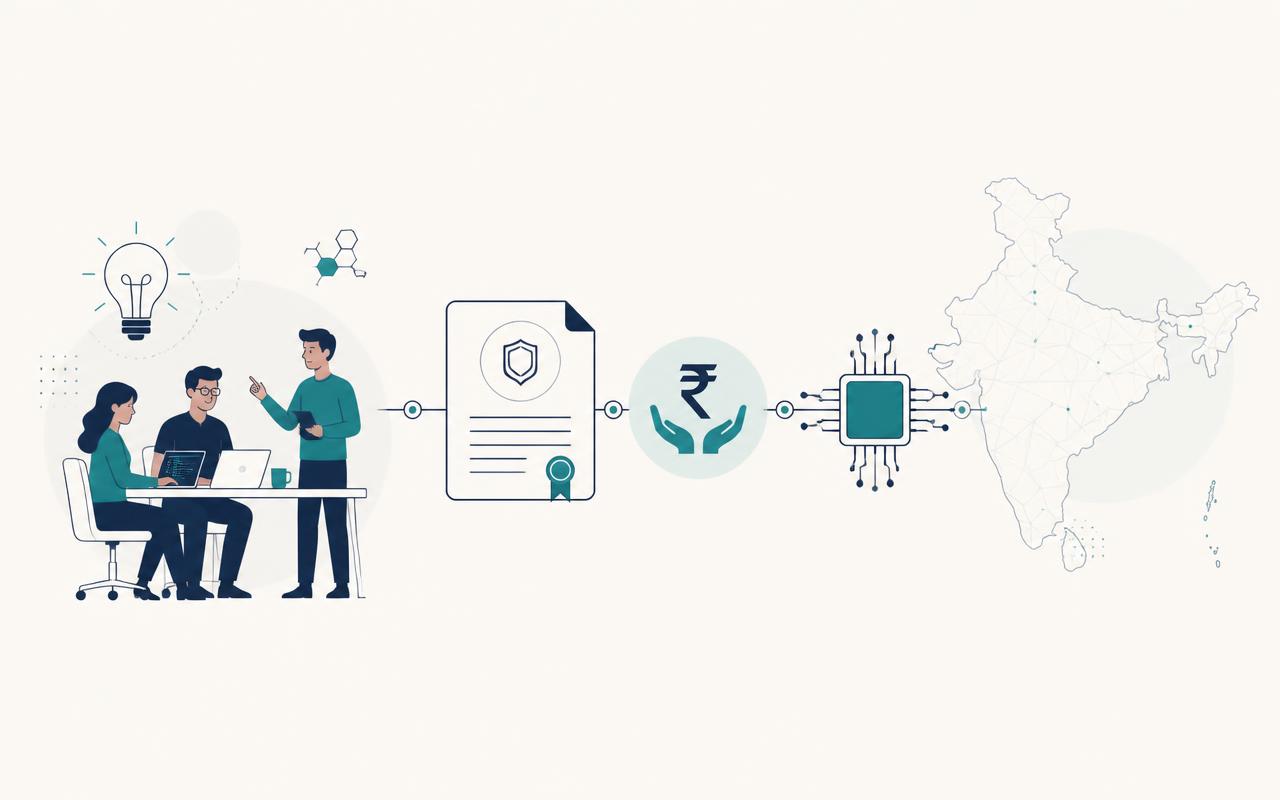
For an early-stage technology company, the hardest part of protecting an invention is rarely the idea — it is converting engineering reality into claim language that is broad enough to matter and specific enough to survive examination. Traditional drafting is expensive, slow, and dependent on one attorney's availability. Founders end up filing thin provisionals to save money, then discover at PCT or national phase that the disclosure does not support the claims they actually need. AI-assisted drafting attacks exactly that gap: it industrialises the production work so senior expertise is spent on scope and strategy.
Start here
- Agentic AI for Patent Drafting
Learn how agentic AI transforms invention capture, semantic patent search, and AI-native drafting workflows.
What are AI patent drafting services?
AI patent drafting services combine large language models, retrieval over patent and non-patent literature, and structured drafting agents with human patent professionals who own every filing decision. The AI layer extracts the invention from disclosures and engineer interviews, aligns it against the closest prior art, proposes independent and dependent claim sets, and drafts the specification, embodiments, and figure plan. The human layer sets claim strategy, validates technical accuracy, and signs off before filing.
Traditional drafting
- 3–6 weeks to first draft
- Cost scales with attorney hours
- Quality varies by drafter
- Prior art reviewed late
- Hard to keep portfolio consistent
AI-assisted drafting
- Days to first draft
- Lower cost per application
- Prior-art-aware claim language
- Consistent terminology and structure
- Attorney review on every draft
What stays human
- Claim scope and strategy
- Patentability judgement
- Inventor and examiner interviews
- Jurisdiction and filing route
- Commercial and licensing posture
Why technology startups are adopting AI patent drafting
Startups adopt AI drafting for four commercial reasons: budget discipline, speed to filing ahead of a launch or funding round, coverage across a widening product surface, and investor diligence that increasingly asks what is actually claimed rather than how many applications exist. AI-native workflows let a seed-stage company file better applications on the same budget, and let a Series A company scale from three filings a year to fifteen without a proportional increase in legal spend.
Where startups feel the difference
- Cost: 30–50% lower drafting cost per application on well-scoped inventions.
- Speed: first drafts in days, so filing can precede a demo, paper, or launch.
- Coverage: more embodiments and alternatives captured, reducing design-around risk.
- Consistency: one terminology standard across every filing in the family.
- Diligence readiness: claim-to-product mapping that investors and acquirers can follow.
Request a Free AI Patent Strategy Consultation
Tell us about your technology and stage. A Hashi patent professional will review your invention landscape and respond with a practical filing strategy — no obligation, fully confidential.
The Hashi AI patent drafting framework
Our framework runs in five stages, each with an AI production step and a human checkpoint. It underpins both our patent drafting services and our end-to-end filing and prosecution work, so the draft you approve is built for the jurisdictions you actually intend to enter.
- 01Invention capture and disclosure structuring
- 02Semantic prior-art search and gap analysis
- 03Claim strategy and scope decisions
- 04AI-assisted claim and specification drafting
- 05Embodiments, alternatives, and figure planning
- 06Consistency, antecedent, and support checks
- 07Patent professional review and filing
Explore the underlying services
- Patent Drafting Services
PhD-level technical drafters and AI-assisted specification development.
- Patent Filing Services
Provisional, complete, PCT, and national-phase filing across major jurisdictions.
How much does AI patent drafting cost a startup?
Cost depends on technical complexity, the number of independent claim sets, and the jurisdictions targeted — not on whether AI is used. What AI changes is the hours consumed by production work. In practice, startups see a materially lower cost per application than a fully manual draft of equivalent quality, and the saving grows across a portfolio because terminology, background, and embodiment libraries are reused. The right question is not the cheapest draft, but the cost per enforceable claim you can actually assert.
Ready to protect your startup innovation?
If you are filing in India, the route, timing, and subsidy position matter as much as the draft itself. Our complete guide walks through startup eligibility, expedited examination, fee reductions, and the provisional-to-complete timeline.
- Patent Filing for Startups in India
Complete guide to eligibility, fees, expedited examination, and filing timelines.
Quality control: what a good AI-drafted application looks like
The checks every draft should pass before filing
- Every claim term has antecedent basis and explicit specification support.
- Independent claims map to the commercial product, not just the prototype.
- Dependent claims ladder through disclosed, enabled alternatives.
- Prior-art references are grounded in real documents, never model-generated citations.
- Enablement and written description are sufficient for the broadest claim asserted.
- Jurisdictional style is correct for the intended filing route.
- A named patent professional has reviewed and signed off before filing.
Risks, confidentiality, and governance
Invention disclosures are among the most sensitive documents a startup holds, and a careless AI workflow can compromise novelty or privilege. Confidentiality controls are non-negotiable: disclosures must be processed in a controlled environment, never used to train third-party models, and covered by an NDA before any technical detail is shared. The second material risk is confident mediocrity — a draft that reads fluently but claims poorly. That is why every Hashi draft carries a mandatory human sign-off and a documented quality baseline.
A practical 90-day IP plan for startups
From first disclosure to filed application
- Days 1–10: run a structured invention capture session and identify the core differentiator.
- Days 10–20: commission a targeted prior-art search and a patentability assessment.
- Days 20–35: agree claim strategy — what to claim now, what to hold for a continuation.
- Days 35–55: AI-assisted drafting of claims, specification, embodiments, and figures.
- Days 55–70: patent professional review, inventor validation, and revision.
- Days 70–90: file the provisional or complete application and set the 12-month PCT plan.
Frequently asked questions
They are patent drafting services in which AI handles production work — invention structuring, prior-art context, claim scaffolding, and specification drafting — while qualified patent professionals set the claim strategy and approve every application before filing. For startups, this lowers cost per application and shortens time to filing without reducing legal quality.
Related resources
- Agentic AI for Patent Drafting
The multi-agent operating model behind AI-native drafting.
- Patent Filing for Startups in India
Eligibility, fee reductions, expedited examination, and timelines.
- Patent Drafting Services
Technical drafting, claim strategy, and specification development.
- Patent Filing Services
Filing and prosecution across the US, EP, IN, JP, and CN.
Build stronger patents with AI-powered intellectual property services
AI does not make patents stronger on its own — disciplined claim strategy, technical accuracy, and expert review do. What AI changes is how much of your budget goes to production versus judgement. Startups that get this balance right file earlier, claim wider, and walk into diligence with a portfolio that stands up to scrutiny.
Book Free AI Patent Strategy Consultation
Talk to a Hashi patent professional about your invention, your filing timeline, and the fastest route to enforceable protection. You can also request a confidential patentability assessment.
Book Free AI Patent Strategy Consultation