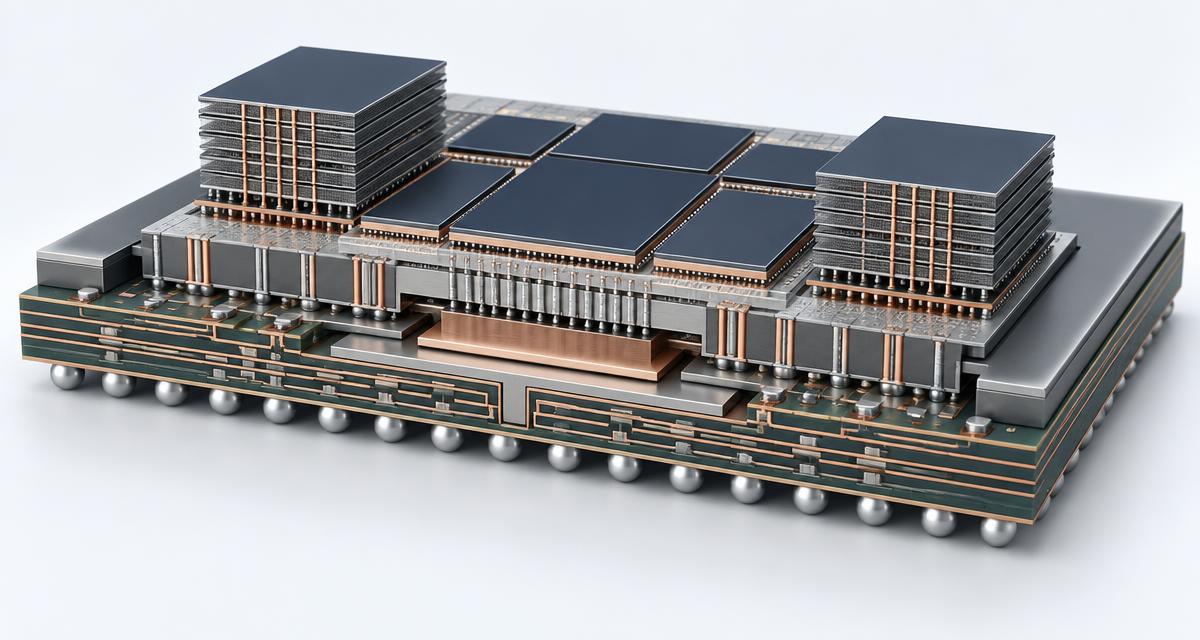
Advanced packaging has moved from a manufacturing hand-off to a system-design decision. Chiplet partitioning, 2.5D and 3D integration, high-bandwidth memory, silicon bridges, hybrid bonding, redistribution layers, thermal paths and package-level power delivery now influence compute density, bandwidth, yield, energy efficiency and time to market. When those capabilities define product performance, the intellectual property around them becomes commercially consequential.
The strategic question is therefore not simply who files packaging patents. It is which claims reach the mechanisms a product depends on; where ownership sits across suppliers and collaborators; how filing activity is shifting between technical layers; and whether a planned architecture enters a field where redesign, licensing, acquisition or further clearance work may be prudent. A useful landscape connects those questions rather than presenting an undifferentiated list of documents.
The Packaging Layer Is Becoming an IP Battlefield
A modern package is an engineered system in its own right. Decisions once treated as implementation details now determine whether multiple compute, memory, I/O and accelerator dies can operate as one product. The package carries high-density signals, distributes power, removes heat, manages mechanical stress and preserves manufacturability across interfaces supplied by different companies. Each function can be protected at the structural, process, circuit, material or system level.
Commercial decisions that increasingly depend on packaging IP intelligence
- Selecting a 2.5D, 3D, fan-out, bridge-based or hybrid architecture for a new product platform.
- Deciding which interfaces, substrates, bonding processes and thermal structures should be developed internally or sourced.
- Evaluating whether a competitor's filing direction signals a move into a target product or supply-chain position.
- Prioritising clearance analysis before layout, tooling and supplier commitments become difficult to reverse.
- Identifying technical spaces where focused R&D and filing could create a defensible position rather than another isolated patent.
- Testing whether an acquired portfolio or partner portfolio actually covers the package mechanisms that matter commercially.
This does not mean every packaging patent creates business leverage. Many documents describe narrow process windows, historical architectures or features that do not appear in a target implementation. Others belong to families whose live claims differ materially by jurisdiction. The analytical task is to separate volume from relevance and relevance from legal conclusion. A landscape can identify potential claim-to-product relationships and areas for deeper review; it should not label infringement or essentiality without the appropriate legal and technical analysis.
"The package is no longer the container around the innovation. In many systems, it is where the innovation becomes commercially possible."
What We Map Across the Advanced Packaging IP Stack
The strongest search architecture follows the physical and functional stack. It begins with a technology taxonomy, not a list of fashionable keywords. Each layer is decomposed into mechanisms, alternative implementations, manufacturing steps and failure modes. Search concepts are then expanded through classifications, citations, assignee history and family relationships before claims are reviewed against the agreed scope.
- 01Chiplets, logic and accelerator dies
- 02HBM and memory integration
- 03Microbumps, hybrid bonding and vertical connections
- 04Silicon interposer, bridge or redistribution layer
- 05Package substrate and power delivery
- 06Thermal, mechanical and reliability structures
- 07Assembly, test, yield and manufacturing control
- 08Board and end-product integration
| Layer | Representative scope | Commercial question |
|---|---|---|
| Package architecture | Chiplet partitioning, 2.5D/3D arrangements, fan-out, bridges, interposers, co-packaging | Which structural choices create differentiation or third-party dependency? |
| Interconnect | Die-to-die links, bumps, TSVs, hybrid bonds, redistribution, signal integrity | Which physical and electrical mechanisms connect the dies? |
| Memory integration | HBM placement, stack coupling, controllers, proximity and memory-package co-design | Where does memory integration intersect packaging and system claims? |
| Thermal and power | Heat spreaders, thermal interfaces, liquid paths, power delivery networks, regulation | What enables sustained performance and power integrity? |
| Manufacturing | Bonding, alignment, wafer/package assembly, test, repair, warpage, yield and reliability | Which process and equipment positions constrain scale-up? |
| Standards and ecosystem | Published interfaces, consortium specifications, supplier roles and interoperability dependencies | Which relationships shape implementation without assuming patent essentiality? |
The taxonomy is adapted to the target technology and decision. UCIe, for example, is treated as an ecosystem and interface context where relevant; an implementation is not described as standardised by UCIe unless the applicable specification and evidence support that statement.
Keep Technology, Standards, Implementations and Patents Separate
Packaging analysis becomes unreliable when four different concepts are collapsed. A technology is a technical capability, such as hybrid bonding. A standard or consortium specification may define selected interface behaviour or interoperability requirements. An implementation is the actual mechanism used in a package or product. A patent contains jurisdiction-specific claims that may or may not read onto aspects of that implementation. Similar vocabulary across those layers does not prove a legal relationship.
- 01TECHNOLOGY — define the capability and alternatives
- 02STANDARD / ECOSYSTEM — identify applicable published requirements
- 03IMPLEMENTATION — document observable product or process evidence
- 04PATENT FAMILY — establish ownership, status and jurisdiction
- 05CLAIM — construe the relevant limitations
- 06DECISION — prioritise monitoring, clearance, design or portfolio action
This separation protects decision quality. A patent mentioning chiplets is not necessarily relevant to a particular die-to-die structure. Participation in an industry consortium does not establish patent ownership or essentiality. A product description using a commercial packaging name does not reveal every internal mechanism. The landscape should preserve these evidentiary boundaries and state what is known, what is inferred and what requires further technical or legal validation.
From Patent Counts to Competitive IP Intelligence
Counts can describe the size of a retrieved dataset, but they rarely answer a strategic question. They are highly sensitive to query design, family consolidation, jurisdiction coverage, legal-status treatment and the classification of borderline documents. A company can appear prominent because it files broadly, because its portfolio contains many related continuations, or because a search vocabulary aligns with its drafting style. None of those facts alone establishes technical leadership or commercial leverage.
A claim-led landscape adds the dimensions that counts omit
- Family-level consolidation so one invention is not mistaken for many independent positions.
- Current assignee and transaction review so ownership is not frozen at the original applicant.
- Legal-status and jurisdiction filters aligned with the markets in which the product will be made, used or sold.
- Claim-theme coding that distinguishes architecture, structure, process, material, circuit and system-level protection.
- Priority and continuation analysis to reveal how a position has evolved and where claim scope is still developing.
- Product and process evidence mapping with an explicit confidence level and source trail.
- Cross-layer dependency analysis showing where a package relies on rights held outside the immediate product company.
Search output
- Documents and families
- Applicants and dates
- Keywords and classifications
- Citation links
Analytical layer
- Claim themes
- Ownership and status
- Technology-to-product evidence
- Jurisdiction and timing
Business decision
- Portfolio priorities
- Competitive monitoring
- Clearance focus
- R&D and partnership choices
Who Is Building the Advanced Packaging IP Position?
The relevant ecosystem extends beyond integrated device manufacturers. It can include foundries, outsourced assembly and test providers, memory suppliers, processor and accelerator developers, substrate and materials companies, electronic-design-automation vendors, bonding and lithography equipment suppliers, research institutes and specialist thermal businesses. The same package may combine technology and contractual rights from several of these groups.
A competitive matrix should therefore map organisations against technical layers and evidence types rather than force a single league table. Public patent records can support observations about filing themes, family structures, jurisdictions and ownership. Product disclosures, technical papers, standards documents, teardown evidence and corporate announcements can support carefully bounded implementation associations. They do not, without further work, prove market share, patent quality, infringement, essentiality or licensing power.
| Ecosystem role | Patent intelligence focus | Business use |
|---|---|---|
| Foundry / manufacturing platform | Integration flows, bonding, interposers, process control and yield | Assess platform dependency and alternative routes |
| OSAT / packaging specialist | Assembly structures, test, reliability and customer-specific integration | Map outsourced capability and supplier concentration |
| Memory supplier | HBM stack, interfaces, thermal structures and package integration | Connect memory choices to package-level rights |
| Logic / accelerator company | Chiplet architecture, die-to-die behaviour, co-design and system integration | Identify product-facing positions and design priorities |
| Equipment / materials supplier | Bonding, deposition, inspection, substrates, underfill and thermal materials | Reveal enabling rights deeper in the supply chain |
| Research organisation | Early architectures, processes and collaborative families | Track emerging concepts and potential transfer paths |
Company names and relative positions should be populated only from a defined, current evidence set. This framework does not imply a ranking.
Where Is the Advanced Packaging IP White Space?
Potential whitespace can be identified through structured analysis of claim coverage, technical alternatives, filing chronology, jurisdiction, ownership and product requirements. It is not an empty cell on a heat map and it is never a guarantee that an invention is patentable or clear to practise. A low-density search result may reflect terminology gaps, confidential know-how, immature technology, expired rights or an incorrectly bounded taxonomy.
- 01Define the target performance constraint
- 02Decompose the architecture into mechanisms
- 03Map live claim themes and alternatives
- 04Locate weakly covered technical combinations
- 05Test adjacent classifications and terminology
- 06Review product need and engineering feasibility
- 07Run focused prior-art and patentability analysis
- 08Translate validated space into R&D and filing action
Commercial whitespace often appears at interfaces: between a thermal structure and a stacked-memory arrangement; between power delivery and a bridge architecture; between known-good-die testing and repair; or between chiplet partitioning and package-level security. These combinations are difficult to find through single-concept searches because relevant claims may be drafted from different engineering perspectives. A structured landscape makes those intersections visible, after which novelty and inventive-step work can test whether a filing opportunity is real.
Validate an opportunity before filing
- Prior art search
Test a technical concept against patents and non-patent literature.
- Novelty search
Assess whether the proposed inventive features appear new before drafting.
- Patent filing and prosecution
Convert a validated technical position into a coordinated filing strategy.
Which Packaging Patents Actually Matter to the Product?
Product relevance begins at the claim, not the abstract. The analyst identifies a live independent claim, breaks it into limitations, and maps each limitation to a packaging mechanism. The mechanism is then compared with reliable evidence about the target implementation. Missing evidence remains missing; it should not be filled with assumption. Dependent claims, prosecution history and family members may change the analysis and are reviewed where the decision warrants it.
- 01PATENT CLAIM
- 02PACKAGING MECHANISM
- 03TECHNICAL IMPLEMENTATION
- 04PRODUCT / PACKAGE
- 05COMPETITIVE EXPOSURE
- 06PRIORITISED NEXT ACTION
The output is an implementation map with transparent levels of potential relevance. A high-priority family may have a live claim whose limitations align with documented package structures in an important jurisdiction. A medium-priority family may require teardown, process or supplier evidence. A low-priority family may share a theme but lack a material limitation. These are triage categories, not infringement conclusions, and they help legal and engineering teams spend deeper review effort where it can change a decision.
| Level | Evidence position | Recommended action |
|---|---|---|
| Priority review | Multiple claim limitations align with reliable implementation evidence | Counsel-led claim review, prosecution-history analysis and technical validation |
| Evidence gap | Potential relevance exists, but a material structure or process is not publicly observable | Targeted teardown, supplier inquiry or process evidence collection |
| Monitor | Related claim theme, uncertain current product connection or developing family | Track family events, product changes and new publications |
| Deprioritise | A material limitation appears absent or the relevant rights are not active in scope | Record rationale and revisit only if the implementation changes |
The labels organise diligence. They are not legal opinions on infringement, validity or enforceability.
Before You Scale the Package Architecture, Understand the IP Risk
Packaging decisions become progressively harder to change. Early architecture choices influence die floorplans, bump maps, substrates, thermal design, supplier qualification, tooling and reliability testing. A focused freedom-to-operate review can be staged alongside those gates: broad landscape intelligence while alternatives are open, targeted claim screening as the architecture stabilises, and counsel-led analysis before launch or a major manufacturing commitment.
Questions an advanced packaging risk review can prioritise
- Which live third-party claims have potential relevance to the selected package architecture or process?
- Which jurisdictions matter based on manufacturing, assembly, import and sales plans?
- Are the relevant mechanisms supplied under agreements that allocate IP responsibility or indemnity?
- Which product facts are observable, and which require confidential engineering evidence under appropriate controls?
- Can an alternative bonding, interconnect, thermal or test approach reduce exposure without compromising performance?
- Which families are continuing, recently assigned, opposed, litigated or otherwise deserving closer monitoring?
Assess Your Advanced Packaging IP Risk
Align claim screening with package architecture, manufacturing locations and commercial markets before design and supplier choices become costly to change.
Assess Your Advanced Packaging IP RiskAdvanced Packaging Patent Intelligence Services
Hashi structures each engagement around the decision, the technical boundary and the evidence available. The scope may cover a full package platform or one mechanism such as hybrid bonding, silicon bridges, HBM integration, thermal management or package-level power delivery. Deliverables are designed for engineering, IP and business teams to use together.
| Service | What it answers | Typical output |
|---|---|---|
| Patent landscape | Where are live rights and filing themes concentrated? | Taxonomy, family set, claim clusters and trend analysis |
| Competitive intelligence | How are selected organisations building positions across the stack? | Assignee-layer matrix, family strategy and monitored signals |
| Technology whitespace | Where may technically and commercially relevant filing space exist? | Evidence-qualified opportunity map and validation priorities |
| FTO / IP risk | Which rights merit deeper review for a defined implementation? | Jurisdiction-filtered claim triage and counsel-ready evidence |
| Patent-to-product mapping | Which claims show potential relevance to products or packages? | Limitation charts, evidence citations and confidence grading |
| Portfolio benchmarking | Does the portfolio cover the mechanisms important to the roadmap? | Coverage, gap and adjacency analysis |
| Partner / acquisition diligence | Does a target portfolio support the stated technology position? | Ownership, status, claim coverage and product-fit review |
| IP strategy | What should be filed, monitored, cleared, acquired or kept as know-how? | Prioritised action plan aligned with engineering milestones |
Why Hashi: Technology-Focused IP Intelligence
Advanced packaging work fails when the technical taxonomy is shallow or the legal dataset is disconnected from the product. Hashi combines semiconductor engineering analysis with patent-family, claim, ownership and jurisdiction review. We build the landscape around mechanisms and evidence, then translate it into the language used by R&D leaders, product teams, patent counsel, licensing groups and corporate strategy teams.
- Technology-first scoping across package architecture, interconnect, memory, thermal, power, manufacturing and ecosystem layers.
- Claim-led review that distinguishes a thematic match from potential implementation relevance.
- Family, status, ownership and jurisdiction analysis suitable for commercial prioritisation.
- Evidence discipline that separates public fact, analytical inference and issues requiring further validation.
- Decision-ready outputs: matrices, maps, claim charts, watchlists and action priorities rather than document dumps.
- Integrated support across patent search, prior art, novelty, FTO, filing and portfolio strategy.
Related IP intelligence
- High Bandwidth Memory Patent Landscape
Explore the IP system around HBM stacks, TSVs, interfaces, packaging and thermal design.
- Patent search services
Build a defensible evidence set for a defined technology or commercial question.
- Freedom-to-operate search
Prioritise third-party rights against a planned product, process and jurisdiction.
- IP intelligence reports
Review research designed for strategic technology and patent decisions.
Advanced packaging patent landscape FAQs
It should cover the technical layers relevant to the decision: architecture, interconnect, memory integration, thermal and power structures, manufacturing, test and ecosystem interfaces. The analysis should consolidate families, check ownership and legal status, review claims, account for jurisdiction and connect selected rights to products or processes using cited evidence.
Know Where Your Packaging IP Position Stands
Whether you are selecting an architecture, entering a partnership, evaluating a portfolio or preparing a new package for market, the useful question is the same: what does the evidence mean for the next decision? Share the technology area and the outcome you need. Please do not include confidential invention details in this initial enquiry.
Request an Advanced Packaging IP Discussion
Tell us the technology area and the decision you are evaluating. We will respond with a focused next step; no confidential invention disclosure is required.