An invention may be new to its inventor. But is it new to the world?
An engineering team can solve a difficult problem without knowing that a related mechanism appears in an earlier patent specification, conference paper or product manual. Independent development and technical merit do not, by themselves, establish patentability. Before investing in drafting and filing, investigate the disclosures that already exist. A prior art search in India is therefore a decision-support exercise: it gives innovators a clearer technical baseline, helps focus professional patentability review and can inform whether to file, refine the invention or investigate further.
For startups, inventors, universities and R&D teams, the cost of uncertainty is practical. Earlier disclosures can change the proposed claim scope, reveal a crowded technical field or indicate where further development would be valuable. Search findings may help avoid unnecessary drafting expenditure, but do not guarantee savings or grant. Hashi IP Solutions combines technical research, AI-assisted discovery and expert-led analysis to turn potentially relevant references into understandable observations rather than an unexplained document list.
What is a prior art search?
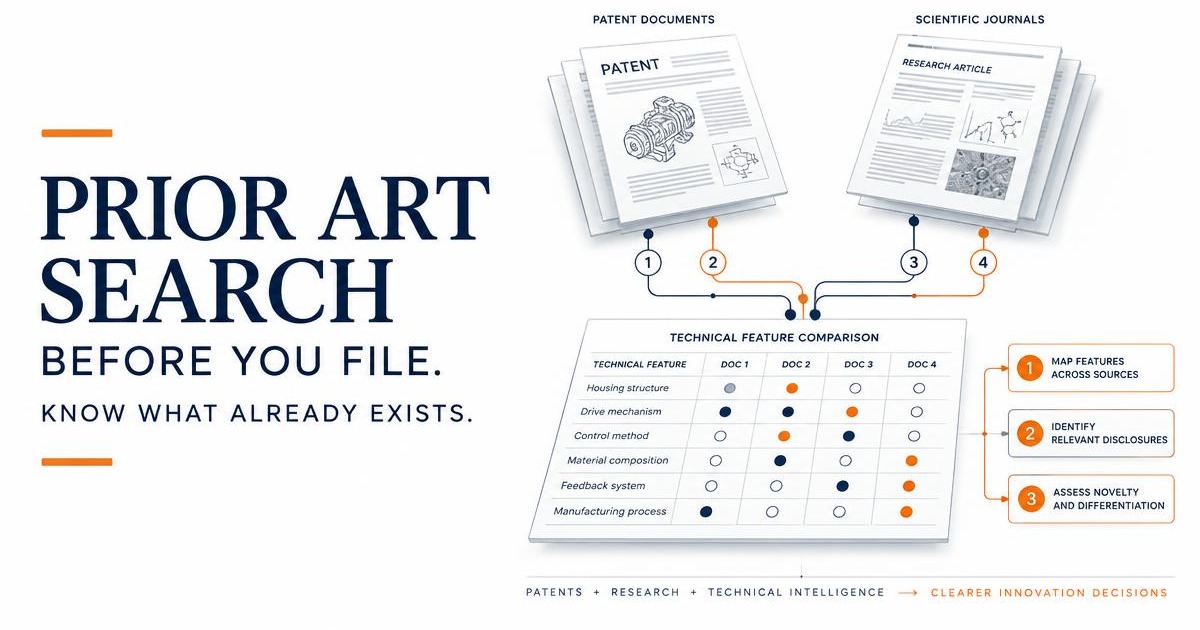
A prior art search is a systematic investigation of existing technical disclosures potentially relevant to an invention. It examines what a document actually teaches, not simply whether its title resembles the invention. Patent literature includes published applications, granted patents, specifications, claims and related patent-family documents. Non-patent literature includes journals, research papers, conference proceedings, standards, manuals and publicly available product documentation. A patent's expired or abandoned status does not, by itself, remove its value as a technical disclosure. The legal effect of a reference depends on the applicable law, dates, disclosure circumstances and claims under assessment.
Patent literature
- Published applications and granted patents
- Specifications, drawings and published claims
- Related family members and translations
Non-patent literature
- Research papers, journals and conferences
- Standards and technical publications
- Public manuals and product documentation
Consolidated evidence
- Record sources and relevant dates
- Compare technical features and passages
- Develop qualified patentability insights
Why search before you commit to filing?
| Decision | What research can contribute |
|---|---|
| Understand existing technology | Identify earlier solutions, architectures and mechanisms addressing the same technical problem. |
| Evaluate novelty concerns | Investigate whether an individual earlier reference discloses the claimed combination of features. |
| Identify inventive-step questions | Identify technical teachings and potential combinations requiring a reasoned professional assessment. |
| Improve patent drafting | Give the drafting professional context for distinguishing features, embodiments and supported claim scope. |
| Avoid unnecessary filing expenditure | Inform the decision to proceed, refine or investigate before committing drafting and filing resources. |
| Identify technology opportunities | Explore alternative mechanisms or development directions without treating a search gap as proven white space. |
A search finding is an input to the decision, not an instruction to file or abandon an invention.
Discuss Your Invention
Start with the technical field, intended filing stage and a non-confidential description of the research objective.
Discuss Your InventionTypes of patent searches: choose the question first
The search objective determines the references, dates, jurisdictions and analytical depth that matter. A pre-filing patentability investigation and a commercial clearance investigation may concern the same product but ask different questions. A patentable improvement can still encounter third-party rights. Likewise, a commercially unobstructed product is not necessarily novel. Define the question before comparing proposals or commissioning a report.
| Search type | Main objective | When to conduct |
|---|---|---|
| Prior art | Identify earlier patent and non-patent disclosures relevant to the invention. | Before filing; also for other evidence-led objectives. |
| Novelty | Investigate earlier disclosure of the invention's essential feature combination. | Preliminary novelty review. |
| Patentability | Support consideration of novelty and inventive step using relevant prior art. | Before drafting and filing. |
| Freedom to operate | Investigate potentially relevant third-party patent rights and live claims in specified markets. | Before launch, commercialization or market entry. |
| Invalidity | Find earlier disclosures relevant to challenging an existing patent or selected claims. | Opposition, revocation or dispute preparation. |
| Patent landscape | Map technology, applicants, patent activity and strategic relationships. | R&D, competitive intelligence and portfolio planning. |
Match the service to your decision
How does prior art search work?
A useful search is iterative rather than a single query. The researcher begins with the proposed technical contribution and revisits the strategy as references reveal terminology, classifications and related mechanisms. The seven stages below describe a structured approach; the agreed scope determines source coverage, date boundaries and reporting depth.
- Invention understanding: define the technical problem, proposed solution, relationships and distinguishing features. Separate essential features from optional embodiments.
- Technology decomposition: break the invention into components, functions, processes and technical relationships. Identify which feature combinations deserve focused investigation.
- Search strategy development: expand keywords, synonyms and concepts; investigate relevant IPC/CPC classes and, where helpful, applicant or inventor names.
- Database searching: examine appropriate patent and non-patent sources. Iterate between broad concept queries and focused classification or feature searches.
- Document identification: select potentially relevant publications, family members, papers and technical disclosures. Record source provenance and bibliographic information.
- Technical analysis: read relevant passages and drawings, compare the invention's features, and distinguish explicit disclosure from inference or unresolved questions.
- Search report and insights: present references, dates, technical summaries, supporting passages and observations requiring further novelty or inventive-step review.
- 01Invention understanding
- 02Technology decomposition
- 03Search strategy
- 04Database search
- 05Reference identification
- 06Technical comparison
- 07Prior art search report
Understand Our Search Approach
Agree the research objective, disclosure boundary and report depth before the search begins.
Understand Our Search ApproachAI-Assisted Patent Discovery. Expert-Led Technical Analysis.
Technical concepts do not have one fixed vocabulary. A patent may describe abnormality detection through classification, segmentation, feature extraction or a decision-support architecture. Keyword searches remain important, but exact terminology alone can miss disclosures expressed differently. Semantic discovery can help surface conceptually related material; classification-led research can investigate mechanisms regardless of wording. These methods complement rather than replace each other. The appropriate mix depends on the invention and the available sources.
Keyword-led discovery
- Exact terms, synonyms and Boolean queries
- Transparent query refinement
- Researcher reviews original disclosures
AI-assisted discovery
- Concept and semantic similarity exploration
- Alternative terminology and candidate passages
- Outputs require source verification
Expert validation
- Read specifications and relevant passages
- Check dates, feature relationships and context
- Record evidence and remaining uncertainty
AI-assisted summaries or relevance scores are retrieval aids, not independent determinations of novelty, inventive step, validity or patentability. A technically similar document may lack an essential relationship; an apparently remote document may teach the relevant mechanism in a different application. Expert review tests the underlying disclosure, checks family context and records the passages supporting each observation. No particular proprietary model, live database integration or automated legal decision is implied by this research framework.
- 01Technical concepts
- 02Semantic discovery
- 03Classification
- 04Document analysis
- 05Expert validation
Patent databases and research sources
No single database contains every relevant disclosure. Sources differ in jurisdictional coverage, indexing, language support, full-text availability and update cycles. Search planning should account for those differences and the possibility of unpublished applications. Public patent resources include Google Patents, WIPO PATENTSCOPE, EPO Espacenet and USPTO Patent Public Search. India-specific search services, including InPASS, should be checked for current availability. Patent Center supports access to US application records; it is not interchangeable with a worldwide discovery tool.
Patent databases
- Public: Google Patents, PATENTSCOPE, Espacenet
- National patent-office search resources
- Commercial examples: Derwent Innovation, Questel Orbit
Scientific literature
- Google Scholar as a discovery starting point
- Journal and conference repositories
- Original publications and supplementary material
Technical disclosures
- Standards and contributions where accessible
- Public manuals and product documentation
- Source, version and disclosure-date evidence
Derwent Innovation and Questel Orbit are examples of commercial platforms, not a statement that Hashi holds subscriptions to every platform listed. Availability and access should be confirmed when defining the engagement. Scientific discovery services can identify leads, but the underlying paper and its disclosure history require review. For standards or online documentation, version history and public accessibility may matter as much as technical content. A source list should explain what was searched and the limitations, rather than imply universal coverage.
Explore public research resources
Practical demonstration: an AI-based medical image analysis system
Consider a hypothetical system that acquires a medical image, preprocesses it, extracts learned features, classifies abnormalities and generates a diagnostic decision-support output. The research task is not simply to search for 'AI diagnosis'. It is to understand which technical relationships are proposed as the contribution: for example, how preprocessing interacts with feature extraction, what inputs the classifier receives and how the decision-support output is generated. Clinical usefulness alone does not establish a patentable technical distinction.
Step 1–2: understand the invention and decompose its features
A researcher would first clarify the imaging modality, input quality, architecture and processing sequence. The feature matrix below turns a broad description into researchable technical questions. It does not define claims or assign patentability to individual components. An actual invention may depend on a relationship between features rather than any one item in isolation.
| Feature ID | Technical feature | Research focus |
|---|---|---|
| F1 | Image acquisition | Earlier medical imaging systems and input formats |
| F2 | Image preprocessing | Filtering, normalization and enhancement approaches |
| F3 | AI model | Earlier machine-learning architectures and training arrangements |
| F4 | Feature extraction | Learned representations and technical extraction mechanisms |
| F5 | Classification | Medical-image classification and abnormality detection |
| F6 | Diagnostic output | Decision-support outputs and their technical generation |
Illustrative decomposition only; no finding about novelty or inventive step.
Step 3–4: expand search concepts and investigate sources
Example concepts include medical image analysis, automated abnormality detection, deep learning-based diagnosis, image segmentation, feature extraction, classification architecture and diagnostic decision support. The researcher would expand these concepts with mechanism-specific synonyms and investigate suitable classifications after understanding the invention. Actual search strings and classes are not assumed here. Candidate references would come from patent publications and families, scientific papers, conference proceedings and relevant public technical documentation. Broad architecture searches and narrower feature-relationship searches would be compared to avoid tunnel vision.
Step 5: compare technical features, not just similar titles
| Invention feature | Reference A | Reference B | Observation |
|---|---|---|---|
| Image acquisition | Disclosed | Not disclosed | Review the mechanism and context |
| Image preprocessing | Not disclosed | Disclosed | Investigate the preprocessing relationship |
| AI feature extraction | Disclosed | Disclosed | Further technical analysis |
| Diagnostic output | Not disclosed | Not disclosed | Further investigation needed |
These labels are fictional. 'Not disclosed' describes only the imagined comparison, not proven absence from the prior art. Combining References A and B does not automatically establish lack of inventive step.
Step 6–7: turn the comparison into a decision-ready report
A professional observation would distinguish what an individual reference teaches, what has not been identified in the reviewed material, which technical differences remain and what needs claim-level or legal review. For the hypothetical system, the interaction between preprocessing, learned features and the output could require further investigation even where each component is familiar. A report should not jump from shared components to an obviousness conclusion. The deliverable would record the search boundary, candidate references, supporting passages and uncertainty so a qualified professional can assess the proposed claim combination.
- 01Medical image analysis invention
- 02F1–F6 technical features
- 03Expanded research concepts
- 04Candidate reference review
- 05Feature comparison
- 06Search report and open questions
What does a prior art search report include?
A useful search report does more than list documents. It helps decision-makers understand why those documents matter. The preview below is a report structure for the fictional medical-image example, not a completed search report or evidence of a real engagement. Scope, sources and reporting depth should be agreed for each matter.
Request a Sample Search Report
Ask about an available non-confidential sample and the report format appropriate to your objective. Availability is confirmed individually; no sample download or delivery is implied.
Request a Sample Search Report| Report component | Information to document |
|---|---|
| Invention overview | Technical problem, proposed mechanism and feature relationships |
| Search methodology | Concepts, keyword expansion, classifications and search boundaries |
| Search databases | Sources actually searched and any access limitations |
| Relevant documents | Identified patent and non-patent references, if found |
| Bibliographic details | Verified publication identifiers, titles, applicants and relevant dates |
| Technical summary | What the original disclosure teaches |
| Feature comparison | Feature-level mapping with unresolved questions |
| Relevant passages | Traceable paragraph, figure, claim or page references |
| Assessment observations | Potential novelty and inventive-step issues for further review |
| Executive summary | Key observations, limitations and next-step options |
No real reference identifiers or dates have been inserted into this demonstration.
Prior art search and Indian patent law
The Indian Patents Act, 1970 separates statutory requirements from the research used to investigate them. Section 2(1)(j) defines an invention as a new product or process involving an inventive step and capable of industrial application. Section 2(1)(ja) defines inventive step through technical advance compared with existing knowledge or economic significance or both, together with non-obviousness to a person skilled in the art. A search helps identify material for these assessments; it does not perform the legal determination by itself.
- Novelty: section 2(1)(l) defines a new invention with reference to anticipation by publication or use before the relevant filing date. Evaluate the actual disclosure, relevant dates and claim features, not merely a matching keyword.
- Inventive step: assess the statutory non-obviousness requirement with a reasoned technical and legal analysis. A collection of references does not automatically establish that a claimed combination is obvious.
- Anticipation and exceptions: sections 29–34 address particular anticipation circumstances and exceptions. Their conditions matter; do not assume a universal grace period or that every earlier disclosure has identical effect.
- Exclusions: section 3 sets out subject matter that is not an invention within the Act. Section 3(k) covers a mathematical or business method, a computer programme per se or algorithms.
Software and AI inventions: investigate the technical contribution
Prior art research remains important for AI, machine-learning, computer-implemented, SaaS and data-processing inventions. Researchers should examine the proposed technical problem, mechanism, architecture and relationships rather than rely on an 'AI' label. Section 3(k) must be considered alongside novelty, inventive step and other statutory requirements. It is not accurate to say that every invention using software or AI is automatically excluded; equally, describing software as technical does not itself establish eligibility. Examination guidance explains administrative practice and should not be confused with statutory text or a guarantee of outcome.
- 01Invention features
- 02Relevant prior art
- 03Novelty considerations
- 04Inventive-step considerations
- 05Qualified patentability insights
Common mistakes to avoid before patent filing
| Common mistake | Better research approach |
|---|---|
| Only exact invention keywords | Expand technical synonyms, concepts and alternative descriptions. |
| Only one database | Use complementary sources appropriate to the field and agreed scope. |
| Ignoring alternative terminology | Study language used in identified references and iterate queries. |
| Ignoring non-patent literature | Include papers, standards and public technical documentation. |
| Overlooking patent families | Review relevant family members, translations and disclosure differences. |
| Ignoring publication and priority dates | Record both and determine the legally relevant chronology; they are not interchangeable. |
| Confusing patentability with FTO | Separate pre-filing assessment from jurisdiction-specific third-party-rights clearance. |
| Reading only titles and abstracts | Review original specifications, drawings, claims and relevant passages. |
| Skipping feature comparison | Map disclosures to technical features and relationships with traceable support. |
| Treating a search as a guarantee | Record coverage and timing limits and seek qualified professional assessment. |
Which industries benefit from prior art research?
The invention's mechanisms should shape the research strategy. A chiplet interface requires different vocabulary, classifications and sources from a pharmaceutical formulation. The following fields illustrate how technical decomposition helps define a useful search objective; they are not claims about completed engagements or database completeness.
- Software and artificial intelligence
AI architectures, computer vision, generative AI, data processing and SaaS: investigate the technical contribution and feature relationships.
- Telecommunications
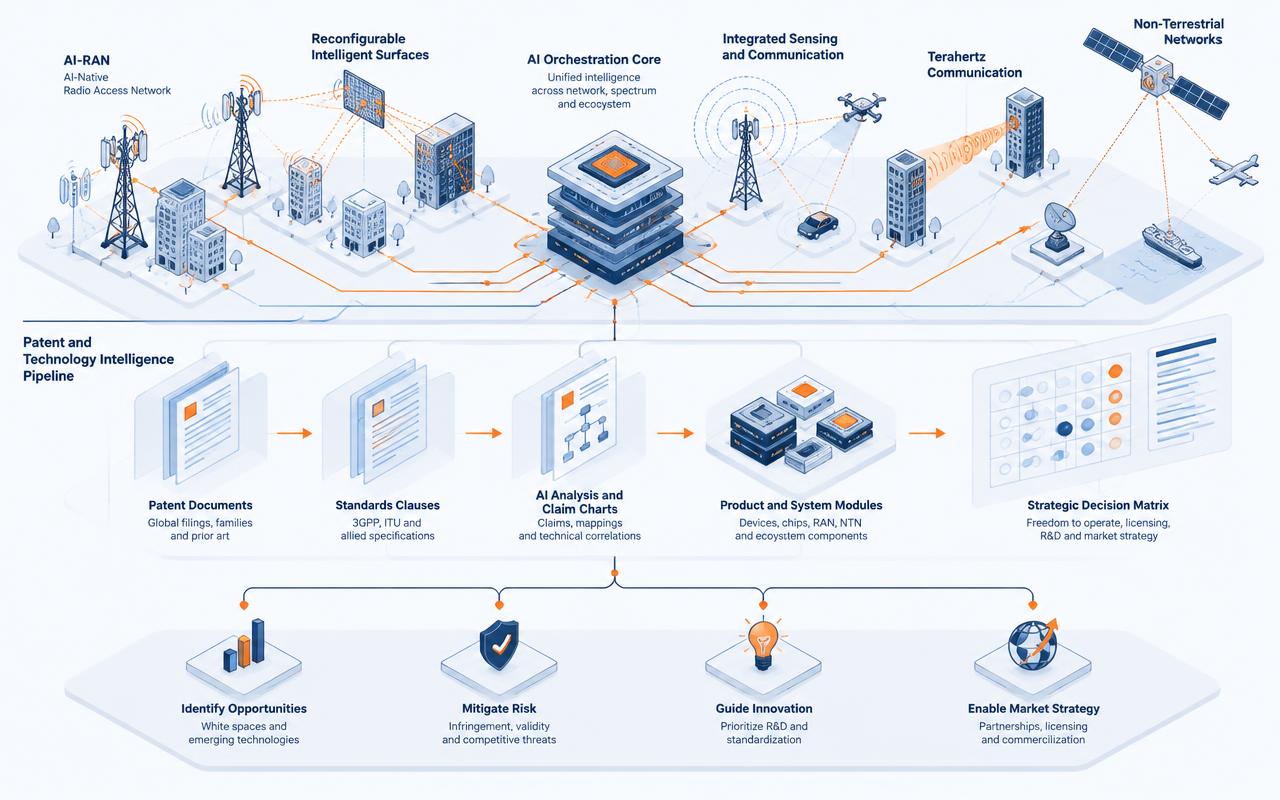
5G/6G, NTN, radio access and signal processing: consider standards-related disclosures and their public availability.
- Semiconductors and electronics
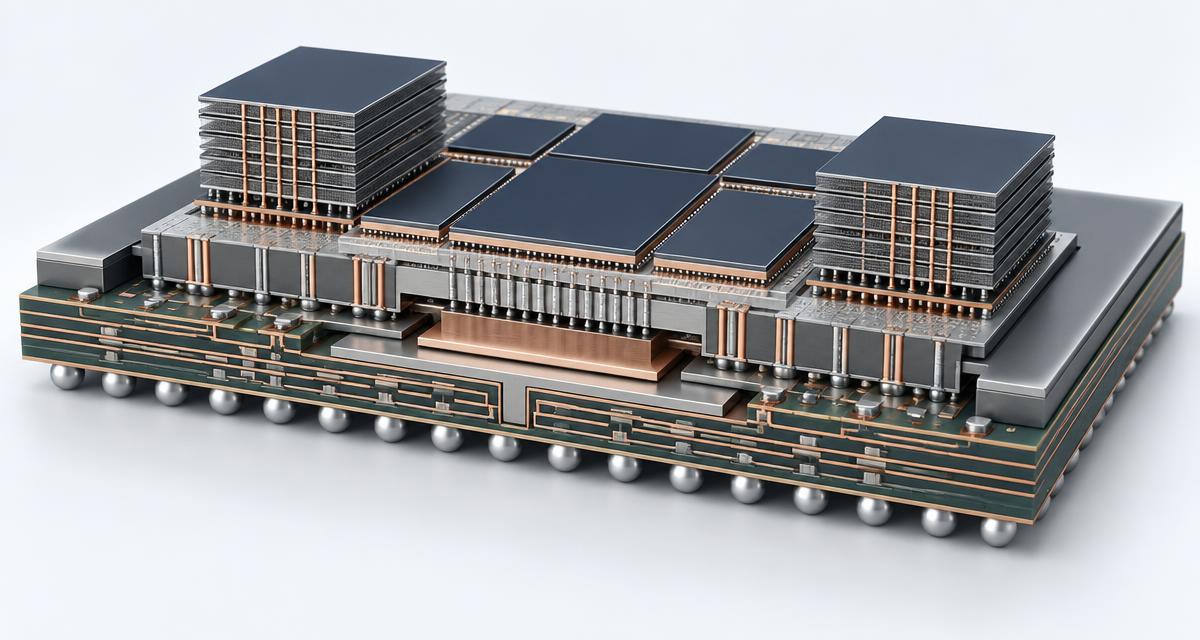
Chip architectures, memory, HBM, chiplets and packaging: decompose interfaces, structures and process sequences.
- Automotive and mobility
ADAS, EV systems, embedded control and V2X: investigate mechanisms across interacting subsystems.
- Healthcare and medical devices
Diagnostic systems and medical electronics: distinguish technical implementation from clinical purpose.
- Pharmaceuticals and biotechnology
Compositions, formulations and processes: investigate disclosure detail and applicable patentability requirements.
- Manufacturing and industrial technology
Automation, robotics and mechanical processes: compare arrangements, functions and operating relationships.
- Energy and cleantech
Batteries, storage and renewables: examine materials, control mechanisms and system architecture.
Discuss Your Technology
Share the technology area and research objective through the existing contact path. Avoid confidential technical information until an appropriate confidentiality arrangement is established.
Discuss Your TechnologyTechnical Understanding. Intelligent Patent Research. Stronger IP Decisions.
Hashi IP Solutions is an AI-native intellectual property firm combining technical expertise with AI-assisted research and IP intelligence. The value of a pre-filing search lies in understanding the invention, investigating suitable evidence and translating references into clear technical observations. Startups need a filing decision they can explain; enterprise R&D teams need visibility into adjacent mechanisms; patent professionals need traceable source material. These needs call for research depth matched to the decision, not a universal report template.
Technical expertise
- Understand architectures, functions and features
- Investigate the proposed technical contribution
- Identify relationships that need deeper review
Intelligent research
- Combine patent and non-patent sources
- Use classifications and AI-assisted discovery appropriately
- Verify original documents and relevant passages
Actionable IP intelligence
- Make comparisons traceable
- Explain limitations and open questions
- Support informed professional and business decisions
- 01Prior art search
- 02Technical analysis
- 03Patentability assessment
- 04Supported claim strategy
- 05Patent drafting
- 06Informed filing decision
Search quality remains bounded by source coverage, disclosure availability, publication timing, terminology and methodology. An unpublished application may not be discoverable; a search that finds no close reference does not prove worldwide novelty. Once the research is reviewed, the next step may be further investigation, refinement or drafting supported by appropriate professional advice.
Frequently asked questions
A prior art search investigates earlier technical disclosures potentially relevant to a proposed invention. It can cover published patent applications, granted patents, research papers and other public materials. Before filing, it helps establish a technical baseline for comparing features and supports professional consideration of novelty and inventive step; it is not a legal verdict.
Discuss your pre-filing search
Please avoid submitting confidential technical information through the public enquiry form until an appropriate confidentiality arrangement has been established. This prepares an email draft for you to send; it does not submit your enquiry automatically.
Request a Prior Art Search
Before you file your next patent, talk to Hashi IP Solutions. Don't File Blind. Search Before You Protect. Understand the existing technology landscape before investing in drafting and filing.
Request a Prior Art Search