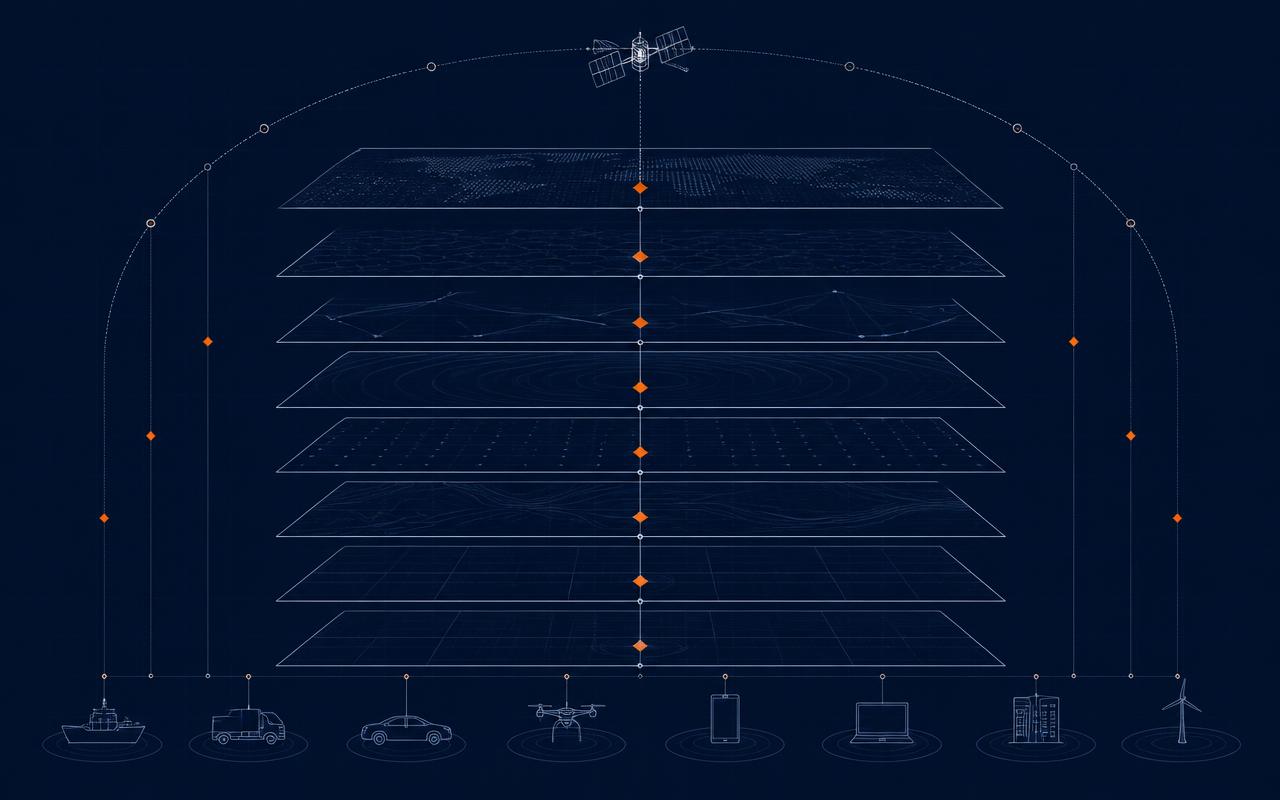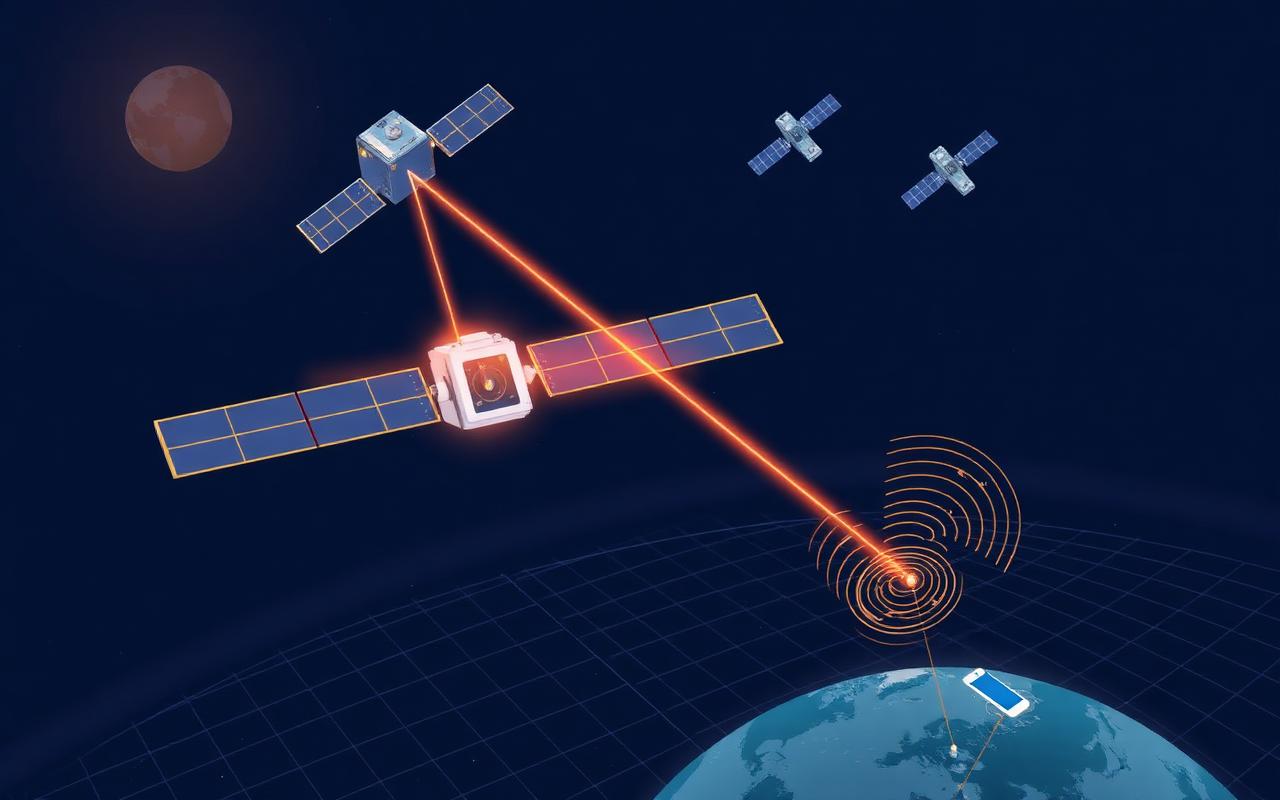
Spectrum sharing is usually filed under regulation — a matter of licences, allocations and administrative coordination. That framing is increasingly incomplete. Once a satellite constellation and a terrestrial network operate in the same band, over the same geography, serving the same devices, the interesting decisions stop being administrative and become computational. Something in the system has to work out, continuously, which transmitter may use which resource under which interference constraint. Whatever performs that calculation is engineering — and engineering that creates commercial advantage is where patent positions form.
Why NTN Spectrum Sharing Is Becoming a Technology Problem
Terrestrial cellular systems and NTN systems were designed under different assumptions and now have to coexist inside one shared spectrum environment. A terrestrial cell has fixed geometry, predictable path loss and a stable neighbour list. A satellite beam has a footprint hundreds of kilometres wide, sweeps across the ground in minutes, illuminates a continuously changing set of terrestrial cells, and operates under power flux density limits that make link budgets tight. Frequency reuse patterns designed for a static topology do not translate cleanly onto a moving one. Traffic demand shifts across both domains on entirely different timescales — terrestrial load follows human geography, satellite load follows orbital geometry.
The coexistence variables that must be reconciled
- Divergent propagation characteristics between satellite and terrestrial links in the same band.
- Satellite beam movement continuously redrawing the interference map.
- Terrestrial cell geometry and reuse planning built around a static topology.
- Uplink and downlink interference conditions that differ by direction and geography.
- Aggressive frequency reuse increasing spatial efficiency while raising coordination burden.
- Power and power flux density constraints limiting the available adaptation range.
- Dynamic traffic demand across two domains with unaligned peaks.
- Time-varying coverage as satellites rise, transit and set.
- Coordination signalling requirements between domains that historically did not talk to each other.
"The commercially relevant question is no longer simply who uses the spectrum, but how the network dynamically decides who can use it, when, where and under what interference constraints."
The Technical Mechanisms Behind NTN Spectrum Sharing
Sharing is not a single feature; it is a set of interacting mechanisms, each of which involves design freedom — and design freedom is where invention lives. The mechanisms below are the ones that most often generate technically distinctive, commercially relevant solutions in NTN deployments.
- 01Interference coordination
- 02Beam-level coordination
- 03Dynamic resource allocation
- 04Frequency reuse strategy
- 05Power & link adaptation
- 06Geographic / spatial coordination
- 07Time-varying coordination
What each mechanism actually has to solve
- Interference coordination — detecting, predicting and mitigating cross-domain interference between NTN and terrestrial transmissions sharing a band, including how coordination information is derived, exchanged and acted upon.
- Beam-level coordination — managing a moving beam footprint against a fixed terrestrial layer, including beam shaping, steering, muting and scheduling that account for which cells are currently illuminated.
- Dynamic resource allocation — assigning time, frequency, power and spatial resources according to instantaneous coexistence conditions rather than a static plan.
- Frequency reuse — pushing reuse factors harder for capacity while keeping the resulting coordination requirement tractable across two domains.
- Power and link adaptation — adapting transmit power, modulation and coding under coexistence constraints without destabilising either network.
- Geographic and spatial coordination — using beam footprints, exclusion zones, terrain and terrestrial coverage maps as first-class scheduling inputs.
- Time-varying coordination — treating coordination as a continuously recomputed problem driven by ephemeris and orbital motion, not a one-time configuration.
Where Spectrum Sharing Can Create Patentable Technical Positions
Mapping mechanisms to candidate IP domains is the step most companies skip. The matrix below is an analytical starting point, not a claim of patentability: each row identifies a potential invention area that requires novelty, inventive-step and claim-level analysis before any conclusion can be drawn — and separate analysis again before any statement about standards relevance.
| Technical mechanism | Potential invention area | Commercial value | Standards exposure |
|---|---|---|---|
| Interference prediction | Predictive coordination | Improved spectrum efficiency | Potentially standards or implementation dependent |
| Beam coordination | Beam-aware interference management | Higher spatial reuse | Standards exposure must be assessed |
| Dynamic spectrum allocation | Adaptive resource scheduling | Increased capacity | Potential standards and implementation overlap |
| Power coordination | Coordinated power adaptation | Interference reduction | Mixed standards exposure |
| Satellite–terrestrial coordination | Cross-domain resource management | Coexistence at scale | Potentially significant ecosystem exposure |
| Measurement and reporting | Coexistence-aware measurement handling | Faster, cheaper coordination | Requires specification-level review |
Candidate IP domains only. Nothing here asserts patentability or essentiality; both require novelty and claim-level analysis against specific prior art and specification releases.
NTN Spectrum Sharing and 3GPP: Where Standards Analysis Matters
The useful questions for an IP team are not what 3GPP is, but which spectrum-sharing behaviours are normative, which are left to implementation, and which sit in the grey band where a specification constrains an outcome without prescribing the method. Coordination procedures, measurement and reporting behaviour, and resource configuration signalling tend to be at least partially specified; the algorithms that decide what to signal usually are not. That distinction determines whether a patent family sits on a licensing path or a differentiation path — and it can only be settled by reading the specification text against the claim text.
- 013GPP work item
- 02Technical contribution
- 03Specification requirement
- 04Implementation
- 05Patent claim
- 06Product
Each layer answers a different question. The work item tells you where technical attention is concentrating and which organisations are investing. The contribution shows what a company proposed, and when. The specification requirement establishes what an implementation must do. The implementation reveals how a vendor chose to do it. The claim defines the scope of the right asserted. The product determines commercial exposure. Collapsing these layers — treating a contribution as proof of essentiality, or a product feature as proof of infringement — is the most common analytical error in NTN IP work.
Related Hashi capabilities
- 3GPP standards mapping
Connect technical mechanisms to specification text
- SEP analysis
Assess potential relationships between claims and standardized functionality
- SEP claim charting
Evidence-backed claim-to-standard mapping
From 3GPP Contributions to Potential SEP Exposure
A defensible assessment follows a repeatable workflow. Skipping steps produces patent counts, not intelligence.
The analytical workflow
- Identify the relevant spectrum-sharing procedures in the target architecture.
- Identify the applicable 3GPP specifications and releases.
- Track technical contributions in the corresponding work items.
- Identify the organisations technically active in the area.
- Search patent families around each technical mechanism, not around keywords.
- Normalise assignees and consolidate family relationships across jurisdictions.
- Map claims to technical functionality at element level.
- Determine potential standards relevance for each mapped claim.
- Perform claim-level analysis against the specification text.
- Build evidence-backed SEP assessments with traceable citations.
NTN Spectrum-Sharing Patent Landscape: What Should Companies Actually Map?
A patent count tells you how much activity exists. A landscape tells you what it means. The difference is dimensionality: a usable NTN spectrum-sharing landscape links technology to families, families to owners and inventors, owners to jurisdictions and legal status, and all of it back to standards activity and shipping products. Only then can a strategy team answer questions like whether a competitor's filings cluster around the exact mechanism their roadmap depends on.
Technology mechanism
Patent families
Applicants & assignees
Inventors
Jurisdictions
Filing trends
Legal status
3GPP activity
Standards relevance
Products
Competitors
= High-quality, enforceable patent draft
NTN Spectrum Sharing White Space: Where Could New IP Opportunities Exist?
White space cannot honestly be declared without research evidence — anyone who names specific open areas before doing the search is guessing. What can be defined is a methodology: decompose the technology into mechanisms, measure filing density per mechanism per jurisdiction over time, overlay standards activity, and look for areas where technical necessity is rising while filing density remains comparatively thin. The dimensions below are where that analysis most often finds something in NTN spectrum sharing.
Potential white-space dimensions to test
- Under-covered coordination mechanisms relative to their technical importance.
- Interface problems between terrestrial and NTN systems rather than within either domain.
- Implementation-specific coordination techniques left open by specification text.
- Adaptive spectrum allocation driven by measured rather than planned conditions.
- Predictive interference management using ephemeris and traffic forecasting.
- AI-assisted spectrum decisions and the training, inference and fallback behaviour around them.
- Cross-layer coordination between scheduling, mobility and beam management.
- Modem-to-network coordination signalling for coexistence.
- Beam-aware resource management at constellation scale.
- Application-aware spectrum allocation tied to service requirements.
Explore NTN white space analysis
Test these dimensions against real filing data before committing R&D budget to a mechanism competitors already own.
Explore NTN white space analysisNTN Spectrum Sharing in Technology Due Diligence
For investors, M&A teams, corporate strategy groups, operators and suppliers, spectrum-sharing capability is often presented as the differentiator in an NTN investment thesis. Diligence has to test whether that capability is defensible or merely functional. A company may have genuinely strong NTN technology and still face material IP exposure from third-party patents or from standards-dependent implementation choices it does not control.
What technology diligence should assess
- Technology architecture and which coordination mechanisms it actually depends on.
- Patent ownership, including inventor mobility and assignment chains.
- Patent density around the specific mechanisms in the roadmap.
- 3GPP participation and contribution history.
- Standards exposure and where the product must follow normative behaviour.
- Competitor positioning across the same mechanism set.
- Freedom-to-operate concerns in target launch markets.
- Licensing exposure and existing dependencies.
- Genuine technology differentiation versus commodity implementation.
NTN IP Due Diligence Before Product or Partnership Decisions
Before a product launch, a supply agreement or a partnership, the questions become concrete and answerable. Each one has a defined evidence standard, and each one is cheaper to answer before the commitment than after it.
The questions to answer first
- Who owns the patents relevant to our coordination mechanisms?
- Which of those patents are in force in our target markets?
- Which families overlap with our product architecture at claim level?
- Which standards and releases are relevant to our implementation?
- Which companies are actively building positions in this area?
- Are there credible freedom-to-operate concerns on our launch path?
- Are there licensing dependencies we have not budgeted for?
- Which technical areas remain relatively open to us?
- What should be monitored continuously after deployment?
Discuss an NTN IP due diligence scope
Scope a focused review against your architecture, target markets and launch timeline.
Discuss an NTN IP due diligence scopeWho Should Monitor NTN Spectrum-Sharing IP?
| Stakeholder | Why it matters |
|---|---|
| Satellite operators | Spectrum coordination, infrastructure and service deployment decisions |
| NTN service providers | Product architecture choices and third-party IP exposure |
| Telecom operators | Terrestrial/NTN coexistence and vendor dependency risk |
| Chipset companies | Modem and RF implementation exposure |
| Infrastructure vendors | Network-side coordination technology and signalling |
| Satellite modem suppliers | Implementation-specific IP and differentiation |
| Automotive companies | Direct-to-device and connected mobility integration |
| Investors and M&A teams | Technology and IP diligence before commitment |
| Patent and licensing teams | Portfolio positioning and potential SEP exposure |
How Hashi IP Solutions Analyses NTN Spectrum-Sharing Risk
Each capability below answers a specific spectrum-sharing question rather than a generic IP need.
- NTN IP landscape — map patents, companies, technologies, jurisdictions and filing activity around defined coordination mechanisms.
- NTN white space analysis — identify under-explored technical areas and potential opportunity zones with filing-density evidence.
- NTN technology due diligence — assess the technology, standards and competitive IP environment around a technology or target company.
- NTN IP due diligence — assess ownership, portfolio exposure, FTO considerations, standards dependencies and commercial IP risk.
- NTN patent search and prior art — investigate specific spectrum-sharing mechanisms and inventions before filing or launch.
- NTN standards mapping — connect technical mechanisms with the relevant specifications, releases and work items.
- NTN SEP analysis — evaluate potential relationships between patent claims and standardized functionality.
- SEP claim charting — detailed claim-to-standard mapping supported by technical evidence.
- NTN patent-to-product mapping — connect patent families with actual NTN implementations and shipping products.
- NTN competitive intelligence — track competitor filings, standards participation and technology positioning over time.
A Practical NTN Spectrum-Sharing IP Intelligence Workflow
The workflow is deliberately linear: each stage narrows the search space for the next, so that claim-level effort — the expensive part — is spent only where the landscape and standards analysis indicate it will change a decision.
- 01Technology question
- 02Technical decomposition
- 03Patent landscape
- 043GPP / standards analysis
- 05Claim-level mapping
- 06White space / FTO analysis
- 07Competitive intelligence
- 08Commercial decision
The Strategic Question Is Bigger Than Spectrum
For NTN companies the question is not merely whether spectrum can be shared. It is: which technical mechanisms enable that sharing, who owns the relevant IP, what does the standards ecosystem require, and where can our technology differentiate without creating avoidable IP exposure? Answering that requires reading engineering, standards and patent evidence as one connected picture — which is precisely how Hashi's NTN intelligence work is structured.
Discuss your NTN IP strategy
Building an NTN spectrum-sharing technology? Understand the patents, standards, competitors and potential IP white spaces surrounding your technology before the next commercial decision.
Discuss your NTN IP strategyRequest an NTN IP intelligence discussion
Tell us the technology area and what you need — landscape, white space, due diligence, patent search, FTO, standards mapping or SEP analysis. We reply with a scoped approach, not a sales pitch.
NTN spectrum sharing: frequently asked questions
NTN spectrum sharing is the coordinated use of the same frequency resources by non-terrestrial networks — satellite and high-altitude systems — and terrestrial networks, or by multiple NTN systems. It relies on technical mechanisms such as interference coordination, beam management, dynamic resource allocation, power adaptation and geographic separation to allow both domains to operate in overlapping bands without unacceptable degradation.