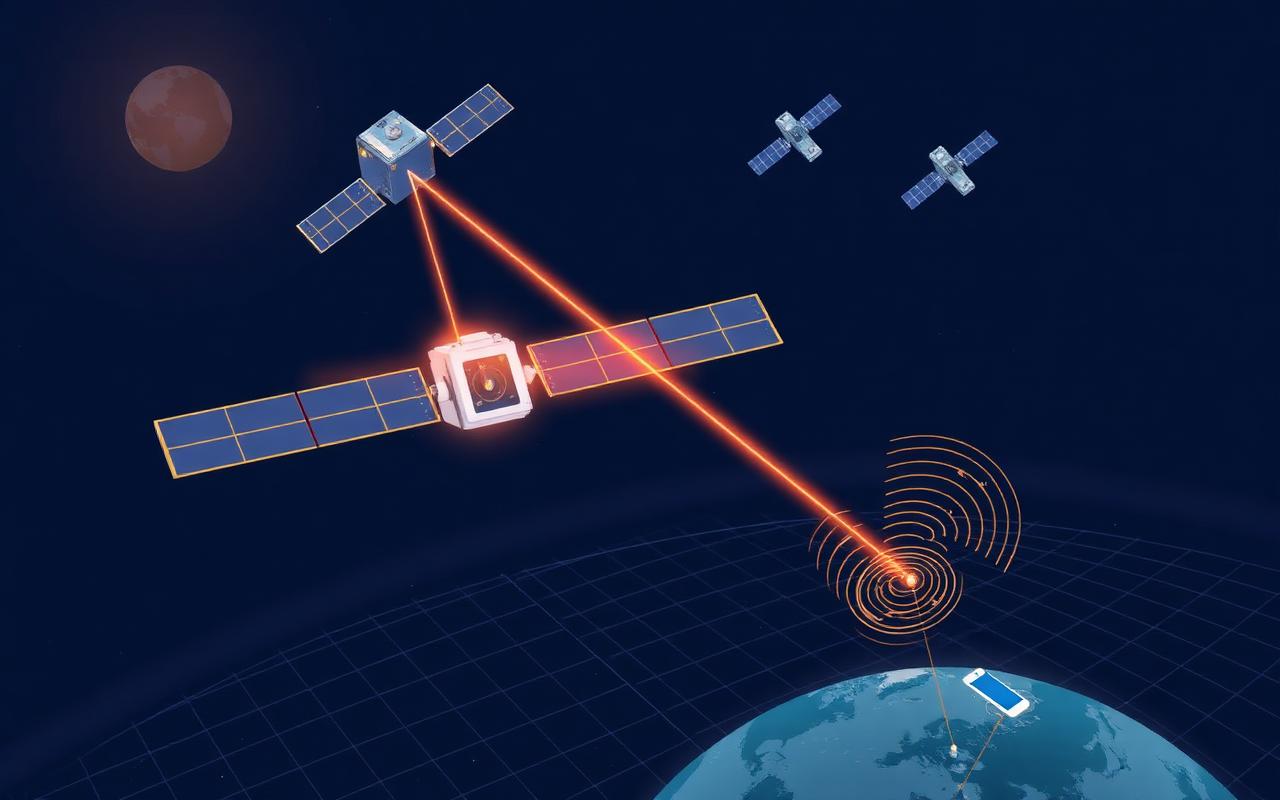
Most NTN analysis still treats the satellite as the interesting object. It is not, commercially. A satellite that cannot hand a live session to a terrestrial network, cannot tell a modem how to point an antenna, cannot be reasoned about by a vehicle's connectivity manager and cannot express its scarcity to an application scheduler is an isolated pipe. The systems being built now are the opposite of isolated — and the engineering effort is concentrating exactly where two differently-designed subsystems must agree.
"Some of the most commercially important NTN inventions may not exist inside a single component. They may emerge at the interfaces between satellite, cellular, modem, antenna, vehicle, software and application layers."
NTN Convergence Is an Architecture Problem
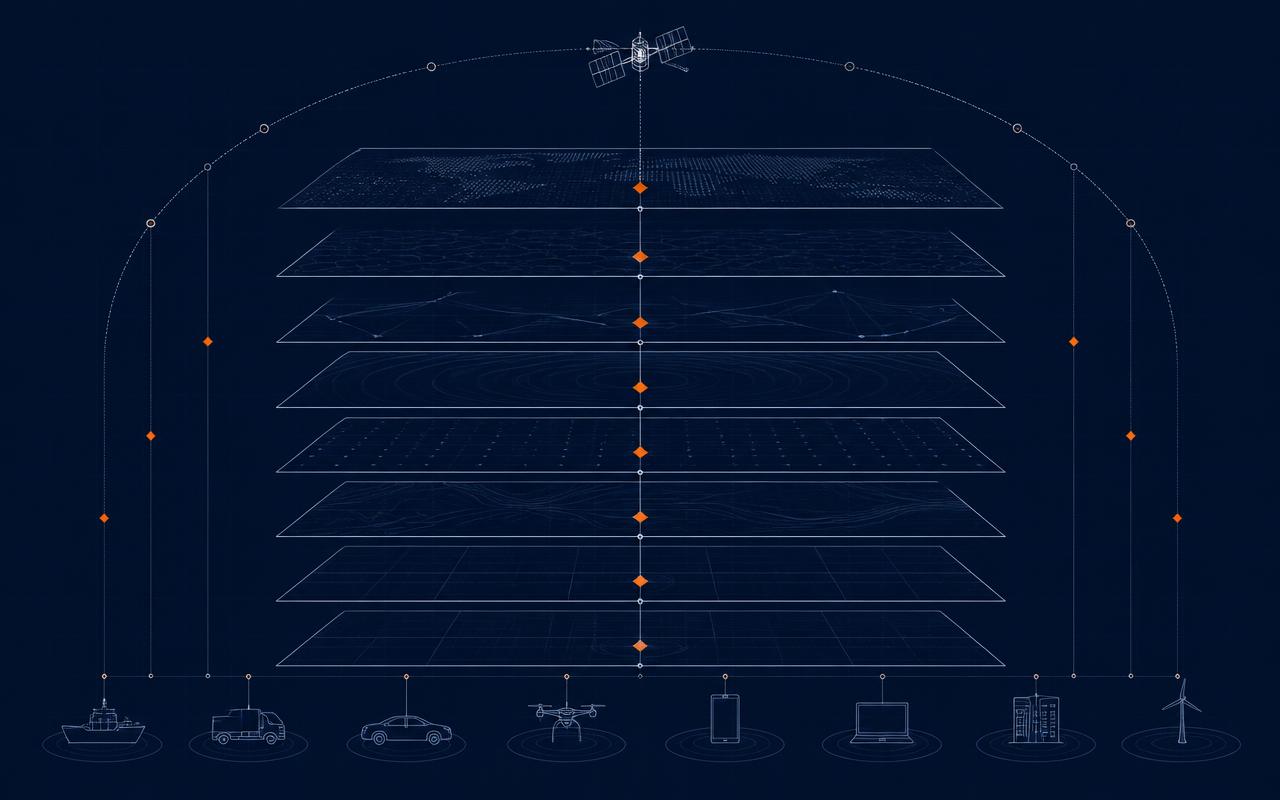
The market is moving from isolated satellite connectivity toward integrated connectivity. A deployed NTN service today is a stack: satellite, NTN radio access, 5G core, terrestrial cellular and other access, modem, RF and antenna, vehicle or device platform, connectivity software, and the applications that consume the link. Each layer has its own suppliers, its own release cycle and its own engineering culture. The system only works when they agree on behaviour — and the agreements are where the difficult, non-obvious engineering lives. The next IP moat may sit at the interfaces rather than inside the individual components.
- 01Application
- 02Connectivity software
- 03Vehicle / device
- 04Modem / RF / antenna
- 05Cellular & multi-access
- 065G core
- 07NTN / RAN
- 08Satellite
NTN ↔ Terrestrial Cellular: The Real Convergence Layer
The convergence boundary is not coverage — it is decision-making. When a device can be served by terrestrial 5G, by satellite NTN, or by both, something must decide which access carries which session, when to move, how to preserve continuity, and how policy, authentication and QoS commitments follow. The hard part is not the transition itself but the coordination: a policy layer that understands satellite geometry, terrestrial load and application requirements simultaneously, and steers traffic before the link degrades rather than after.
Terrestrial 5G
Connectivity policy
Satellite NTN
= High-quality, enforceable patent draft
Potential invention areas at this boundary include predictive access selection, application-aware network switching, session continuity across access technologies, policy coordination between terrestrial and non-terrestrial domains, multi-access traffic steering and failure recovery. The commercial value is connectivity resilience, service continuity, reduced outage and differentiated connected services. The standards question is separate and must be asked separately: which 3GPP system architecture and mobility procedures does the behaviour touch, and is the relevant behaviour normative or implementation-specific?
Modem ↔ Antenna: Where RF Intelligence Becomes System IP
Beam acquisition, antenna orientation, RF adaptation, Doppler compensation, power control, antenna selection, link quality prediction and modem configuration are usually described as separate disciplines. In an NTN terminal they are one control problem. The modem knows the protocol state and the link statistics; the antenna subsystem knows what it can physically do; neither can optimise the link alone. Inventions emerge from the interaction — how modem-side prediction drives antenna configuration, and how antenna behaviour is fed back into modem decisions.
- 01Link conditions
- 02Modem prediction
- 03Antenna / RF configuration
- 04Link optimisation
- 05Updated measurements
This matters commercially wherever the terminal is constrained: automotive terminals with fixed mounting and limited aperture, handheld devices with power and thermal ceilings, IoT endpoints with duty-cycle budgets, industrial terminals and robotics. The constraint is what forces invention. A terminal that can hold a usable link where a competitor's cannot is a product advantage that can, in principle, be protected — subject to novelty, prior art and claim scope analysis.
Modem ↔ Vehicle: NTN Moves Into the Vehicle Architecture
Inside a vehicle, the NTN modem is not a peripheral — it sits behind a telematics control unit, on vehicle Ethernet, under a connectivity manager, alongside GNSS, and subject to vehicle state and power state. ADAS, infotainment, OTA, telemetry and emergency services all want the link, with radically different tolerance for latency, cost and interruption. The valuable invention may concern how vehicle state and application requirements influence NTN connectivity decisions, rather than the radio link itself.
- 01Vehicle applications (ADAS, infotainment, OTA, telemetry, eCall)
- 02Connectivity manager
- 03NTN / 5G modem
- 04RF / antenna
The business context is connected cars, fleet connectivity, emergency communication, remote diagnostics, OTA campaigns and rural or coverage-gap connectivity. For OEMs and TCU suppliers this is also where supplier boundaries and IP ownership become entangled: the modem vendor, the TCU integrator, the software supplier and the OEM may each contribute to a behaviour that no one of them fully owns. See our work in <a href="/industries/automotive-mobility">automotive and mobility</a> and <a href="/industries/telecommunications">telecommunications</a>.
Satellite ↔ Vehicle: The New Connected-Vehicle Boundary
A moving vehicle under a moving constellation is a prediction problem with two trajectories. Satellite visibility, vehicle trajectory, antenna constraints, terrain and location awareness together determine when a usable connectivity window exists. Systems that anticipate those windows behave differently from systems that discover them: they can schedule a large OTA transfer into a predicted high-capacity pass, defer non-urgent telemetry, and pre-position state before a gap. That is trajectory-aware connectivity management, and it is a materially different technical proposition from generic satellite coverage.
Reactive connectivity
- Link discovered when attempted
- Transfers fail and retry
- Coverage gaps surface as outages
Predictive connectivity
- Windows computed from ephemeris and trajectory
- Traffic scheduled into predicted capacity
- State pre-positioned before a gap
Connectivity ↔ Software: The Rise of the Connectivity Orchestrator
Above the modems sits a software layer that decides which network, when, for which application, under what QoS, at what cost and within what power constraint. This orchestrator is becoming the strategic layer of the stack, because it is where product behaviour is actually defined and where it can be updated after deployment. Potential inventions include predictive connectivity, policy-driven access selection, application-aware traffic steering, multi-access routing, connectivity prediction and graceful degradation under constrained links.
- 01Applications
- 02Connectivity orchestrator
- 035G / NTN / Wi-Fi / other access
- 04Modems and RF
Network ↔ Application: Who Gets the Satellite Bandwidth?
Satellite capacity is scarce, expensive and variable. That makes it a resource allocation problem rather than simply a connectivity problem. When capacity is insufficient for everything, application semantics — not just packet markings — should influence network behaviour: what the traffic means, whether it can be deferred, compressed, summarised or dropped without harm.
| Priority | Traffic class | Tolerance |
|---|---|---|
| 1 | Emergency communication | None — must transit immediately |
| 2 | Safety telemetry | Seconds; degradation unacceptable |
| 3 | Navigation and assistance data | Compressible, partially cacheable |
| 4 | Diagnostics | Deferrable, batchable |
| 5 | Infotainment | Best effort, degrade gracefully |
| 6 | OTA software campaigns | Fully deferrable to predicted capacity |
Illustrative only; actual policy depends on product, jurisdiction and operator configuration.
The IP angle here spans application-aware scheduling, bandwidth allocation, adaptive compression, store-and-forward behaviour, traffic prioritisation and network-aware application adaptation — the reverse direction, where the application changes what it sends because of what the network reports.
AI-Native Connectivity Orchestration
AI in this stack is a mechanism, not a marketing claim. The useful formulation is narrow: a model consumes inputs — satellite ephemeris, vehicle trajectory, link quality, network congestion, application priority, historical connectivity, power state, cost — and produces decisions: access selection, handover timing, resource allocation, transmission adaptation, traffic prioritisation. The question that matters for patentability is not whether AI is used, but what technical system behaviour changes because of it. A position is stronger when the model produces a concrete, measurable technical effect in the communication system rather than an abstract classification.
- 01Data
- 02AI / ML model
- 03Prediction
- 04Connectivity decision
- 05Network action
- 06Measurable system effect
Where the IP Opportunities Are
Read the convergence stack as a matrix rather than a list. Each interface has a characteristic technical problem, a plausible IP domain, a business value driver, and a degree of standards exposure that must be verified rather than assumed.
| Interface | Technical problem | Potential IP domain | Business value | Standards exposure |
|---|---|---|---|---|
| NTN ↔ Cellular | Access selection, session continuity, policy coordination | Multi-access steering, predictive selection, recovery | Service continuity, reduced outage | High — touches 3GPP system architecture and mobility procedures |
| Modem ↔ Antenna | Beam acquisition, Doppler and power adaptation | Joint modem–antenna control, link prediction | Terminal performance and cost | Mixed — partly normative radio behaviour, largely implementation |
| Modem ↔ Vehicle | Vehicle and power state driving connectivity decisions | Connectivity management, integration architecture | Connected services, OTA reliability | Low to moderate — mostly outside 3GPP scope |
| Satellite ↔ Vehicle | Trajectory-aware window prediction | Predictive link selection, scheduling | Coverage-gap continuity, fleet reliability | Moderate — assistance data and ephemeris handling |
| Connectivity ↔ Software | Orchestration across heterogeneous access | Policy engines, multi-access routing, degradation | Platform control point, post-deployment updatability | Low — largely implementation-specific |
| Network ↔ Application | Allocation of scarce capacity by application semantics | Application-aware scheduling and adaptation | Cost per delivered outcome | Mixed — QoS frameworks are standardised, policy is not |
Technical relevance does not by itself establish patent validity, infringement, or standard essentiality.
Standards & 3GPP Due Diligence
Five things are routinely conflated: the standard, the implementation, the patent, the product and the deployment. A specification states a requirement; an implementation realises it in one of several lawful ways; a patent claim covers some technical solution that may or may not be the one implemented; a product ships a particular build; and deployment happens in specific markets under specific legal status. Commercial conclusions require all five to line up, not just the first and third.
Questions that make a standards assessment defensible
- Which 3GPP release applies to the behaviour in question?
- Which work item introduced the functionality?
- Is the behaviour normative, or informative description?
- Is it mandatory, or an option an implementation may lawfully omit?
- How does the commercial product actually implement it?
- Does a patent claim read on the actual implementation?
- Does the relevant patent remain in force and enforceable in the target market?
- 013GPP specification
- 02Technical requirement
- 03Implementation
- 04Patent claim
- 05Product
- 06Commercial deployment
Need patent-to-standard mapping?
- SEP claim charting
Claim elements mapped to specification clauses with traceable evidence.
- Standards mapping
Connect 3GPP releases and work items to patent activity.
- SEP analysis
Assess declared portfolios against normative behaviour.
Product-to-Patent Mapping
Conventional keyword patent searching starts from language. Product-to-patent mapping starts from the product: decompose the architecture into features, find the patents that plausibly read on those features, analyse the claims, map the standardised portions, verify legal status, and only then express commercial risk. It is slower, and it is the only version of the exercise that survives contact with a negotiation or a diligence room.
- 01Product architecture
- 02Feature decomposition
- 03Patent discovery
- 04Claim analysis
- 05Standards mapping
- 06Legal status
- 07Commercial risk
Related capabilities
- Patent search
Structured discovery across the convergence stack.
- Patent analytics
Cluster a fragmented filing space by technical function.
- Freedom to operate search
Assess third-party rights before architecture locks.
- AI patent search & analytics
Scale discovery without losing claim-level rigour.
Commercial Deployment Due Diligence
Before an NTN product, partnership or acquisition is committed, eight questions decide whether the technology story holds.
Deployment diligence checklist
- Technology — is the technology genuinely differentiated, or an integration of standard parts?
- IP — what actually protects the differentiation, and at what claim scope?
- Standards — which standardised functions does the product depend on?
- Product — where in the shipped architecture is the technology implemented?
- Deployment — in which markets is it commercially deployed today?
- FTO — which third-party rights could constrain commercialisation?
- Scalability — can the technology scale across markets and product categories?
- Valuation — does the IP create defensible commercial value, or only optics?
- 01Technology
- 02IP
- 03Standard
- 04Product
- 05Deployment
- 06Value
The NTN Convergence IP Map
Where layers meet, invention often becomes system-level. Reading the eight-layer map as a whole — satellite, NTN/RAN, 5G core, cellular and multi-access, modem/RF/antenna, vehicle or device, connectivity software, application — makes clear why single-domain patent searches under-serve this field: the filings that matter often describe a behaviour that spans three layers and is classified under only one.
| Layer | Scope | Interface above |
|---|---|---|
| 1 — Satellite | Payload, orbit, footprint, ephemeris | Access and feeder-link behaviour |
| 2 — NTN / RAN | Radio access, scheduling, mobility | Core interface and session handling |
| 3 — 5G Core | Session, policy, authentication | Access selection policy |
| 4 — Cellular / multi-access | Terrestrial 5G, Wi-Fi, other bearers | Steering and continuity |
| 5 — Modem / RF / antenna | Baseband, front end, beam control | Terminal integration |
| 6 — Vehicle / device | TCU, connectivity manager, power state | Platform connectivity API |
| 7 — Connectivity software | Orchestration, prediction, policy | Application intent |
| 8 — Application | Traffic semantics and tolerance | — |
Interface rows, not layer rows, are where cross-domain invention typically concentrates.
What Investors and Acquirers Should Actually Ask
Fifteen diligence questions
- Technology — what is genuinely differentiated, versus integrated from suppliers?
- Technology — which parts of the stack does the target actually build?
- Technology — does the differentiation survive a supplier change?
- IP — does the portfolio protect the architecture, or only individual components?
- IP — are the interface behaviours claimed, or only the components either side?
- IP — what is the geographic coverage relative to the target markets?
- Standards — which product behaviours are driven by 3GPP requirements?
- Standards — are declarations supported by claim-level analysis, or only by declaration?
- Standards — which release and work item does the relevant behaviour trace to?
- FTO — which third-party claims could constrain deployment?
- FTO — has FTO been assessed for the shipped implementation, not the concept?
- Commercial — is the patented technology actually present in the deployed product?
- Commercial — how much of the revenue depends on the protected behaviour?
- Commercial — what licensing obligations already attach to the stack?
- M&A — does the target's IP create strategic leverage beyond its current product?
Hashi IP Solutions — NTN Convergence Intelligence
Map the technology. Understand the standard. Assess the IP. Validate the commercial exposure. We analyse the convergence layers together rather than as separate searches, because the questions that decide value sit between them.
Capability stack
- NTN patent intelligence
- 3GPP and standards intelligence
- Patent-to-standard mapping
- SEP claim charting
- FTO and product mapping
- Technology and competitive intelligence
- IP due diligence
- M&A and investment technology due diligence
Explore the underlying services
- Patent monetization
Convert convergence positions into licensing outcomes.
- IP management
Govern a portfolio that spans several technical domains.
- AI-powered IP intelligence
Machine-scale analysis with human claim-level review.
- AI IP knowledge graph
Connect standards, patents, products and companies.
Building, Investing in or Commercializing NTN Technology?
Hashi IP Solutions can help evaluate the technology, patents, standards, competitors and commercial deployment risks before the next strategic decision.
Discuss your NTN IP requirement
Hyderabad, India — supporting clients across India, the United States, Europe and Asia. Confidential assessments available under NDA.
Discuss your NTN IP requirementRequest a confidential NTN convergence assessment
Tell us the technology area and requirement — NTN patent landscape, 3GPP and standards intelligence, SEP analysis, FTO, competitive intelligence, IP due diligence or M&A technology due diligence — and we will respond with a scoped approach.
Frequently Asked Questions
Frequently asked questions
NTN convergence is the integration of satellite non-terrestrial networks with terrestrial cellular, modems, antennas, devices, vehicles, connectivity software and applications into a single connectivity layer. Instead of satellite being a separate channel, access decisions, mobility, policy and traffic management are handled across terrestrial and non-terrestrial paths together.
Related NTN & telecom intelligence
- Regenerative NTN payloads: patent landscape, satellite gNB & 3GPP IP opportunities
Onboard processing, inter-satellite links and feeder-link switching.
- From LTE to the stars: why NTN core technology patents are the next SEP goldmine
Foundational NTN technologies and the SEP landscape.
- 3GPP intelligence services
Turning releases, specifications and TDocs into competitive IP advantage.