EVIDENCE LEVEL 01
6G-related technology
A patent describes a technology being researched for 6G. This is a technology association, not evidence of a standards requirement.
6G · Claim analysis · Standards evidence
Connect 6G Patent Claims with Emerging Standardisation Requirements
As 6G technologies evolve through research, standardisation and technical specification development, establishing the relationship between patented inventions and standardised technical requirements becomes increasingly important.
Hashi IP Solutions provides specialised 6G Patent-to-Standard Mapping services to analyse patent claims against relevant 6G technical specifications, standards contributions and emerging normative requirements, where available.
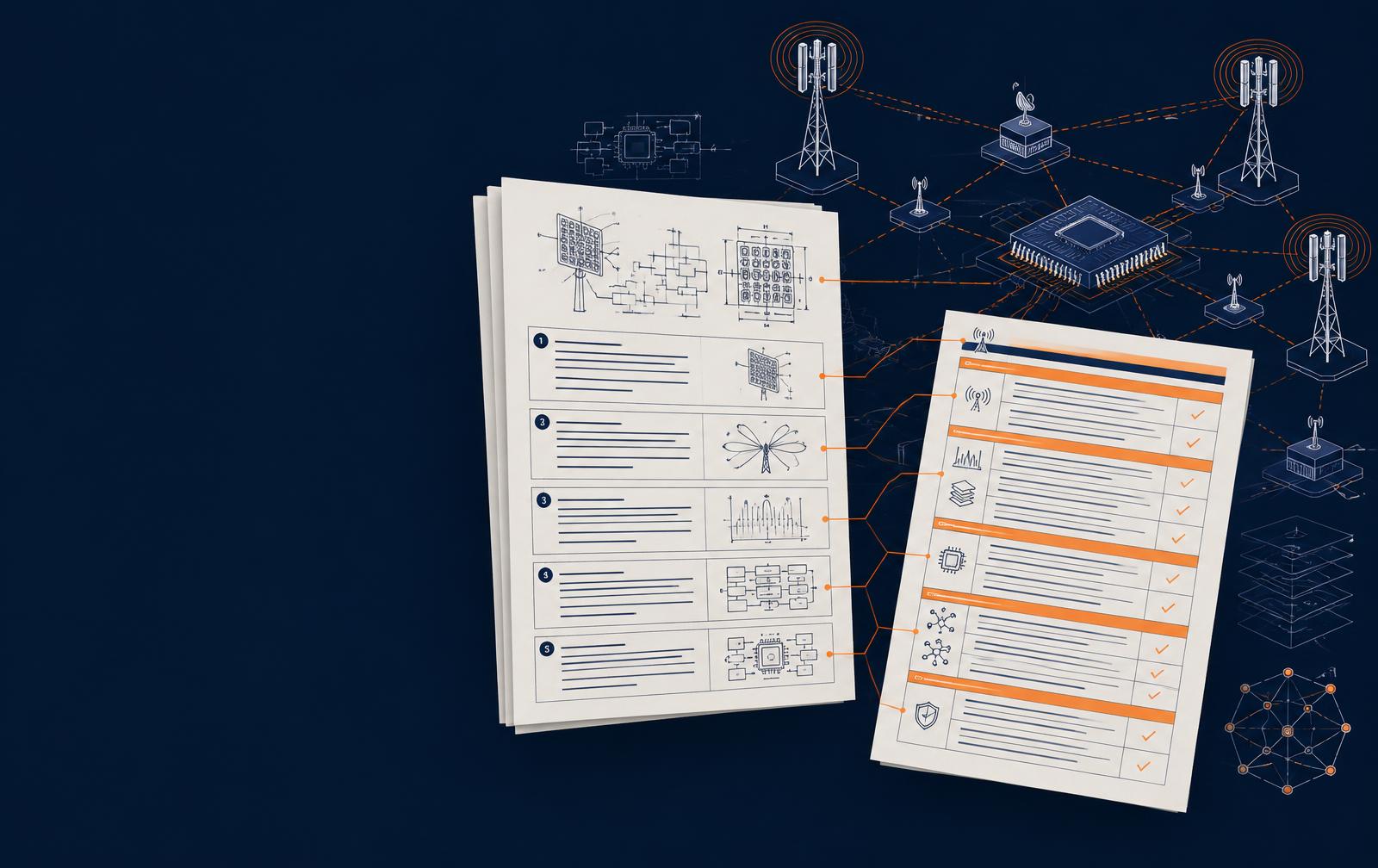
Illustrative claim-to-requirement concept · not actual patent or specification evidence
The mapping question
EVIDENCE LEVEL 01
A patent describes a technology being researched for 6G. This is a technology association, not evidence of a standards requirement.
EVIDENCE LEVEL 02
A claim element appears to correspond to a proposal or technical requirement. The source status and unverified elements remain explicit.
EVIDENCE LEVEL 03
Claim elements are mapped to cited normative requirements in an identified specification version, where available. This still requires claim-scope and expert review.
Technical similarity does not automatically establish standard essentiality. Research proposals, draft documents and adopted normative requirements are different evidence categories; mapping alone is not a legal SEP essentiality determination.
For broader portfolio context, explore our 6G SEP Patents intelligence services.
Six-stage technical review
01
Identify relevant 6G patent publications, granted patents, patent families and claims. Agree the jurisdictions, claim versions and technical questions to be evaluated.
02
Classify selected claims by emerging 6G technology domain, architectural component and technical function to focus the document review.
03
Review available 6G-related specifications, working documents, contributions and technical proposals. Record document identifiers, dates and versions; distinguish published specifications from drafts and research-stage proposals.
04
Break independent and dependent claims into technical elements, retaining claim dependencies. Identify corresponding passages, clauses and requirements in the relevant source documents.
05
Document technical correspondence and supporting references alongside alternative interpretations, unmapped elements and limitations. Separate proposal-level alignment from normative requirement mapping.
06
Prepare structured charts with patent references, claim elements, specification references, technical explanations and evidence status. Report version-sensitive findings for portfolio and specialist review.
Technical scope
Map AI/ML-assisted physical-layer, adaptive-transmission and intelligent radio-resource claims to documented model, signalling and radio-function proposals or requirements.
Compare next-generation RAN architecture, distributed intelligence and coordination claims with documented node roles, interfaces and network procedures.
Decompose joint sensing–communication claims and examine corresponding sensing functions, signal configurations and measurement procedures in available documents.
Evaluate THz propagation, beamforming and high-frequency communication claims against relevant research and contribution evidence, without assuming adopted 6G spectrum requirements.
Map programmable-surface and intelligent-propagation claim elements to proposed control, configuration and channel-management functions, recording their development status.
Examine satellite-integration, aerial-platform and terrestrial–non-terrestrial connectivity claims against relevant mobility, timing and coordination functions under 6G study.
Compare spectrum-utilisation, waveform and advanced physical-layer limitations with documented signal structures, transmission procedures and candidate requirements.
Map transmission, scheduling and reliability mechanisms to available procedural requirements and proposals; performance aspirations alone do not demonstrate claim correspondence.
Decision-ready documentation
Patent expertise × telecommunications knowledge
Claim limitations, dependencies and technical meaning guide the mapping—not broad keyword overlap.
Radio, network and protocol context supports interpretation of the technical functions behind a potential match.
Study activities, contributions and specification development are evaluated as distinct document stages.
Source identifiers, versions and publication status remain traceable throughout the technical review.
Charts preserve supporting passages, rationale, alternative interpretations and gaps for specialist review.
Family-level context and technology classification connect detailed claim analysis with portfolio decisions.
Commercial relevance
Understand which claims have documented technical correspondence and which require further evidence.
Review claim relationships to evolving radio and equipment requirements before making IP strategy decisions.
Evaluate mapped claims around architecture, interfaces and network coordination functions.
Connect claimed innovations to technical contributions while separating research alignment from adopted requirements.
Assess claim-to-requirement relationships for emerging baseband, RF and communication-processing technologies.
Prioritise further review using mapping status, evidence maturity and version-sensitive portfolio views.
Access traceable technical analysis for claim-scope review and licensing preparation without replacing legal advice.
Track how claimed technical functions relate to evolving standardisation directions and document changes.
Discuss a mapping engagement
Evaluate the technical relationship between your 6G patent claims, emerging standardisation requirements and relevant technical specifications.
Engage Hashi IP Solutions for structured 6G Patent-to-Standard Mapping and technical evidence analysis.
Share non-confidential scope through our existing contact workflow. Agree a suitable transfer method before sharing confidential portfolio materials.
Questions & answers
It is claim-level technical comparison of 6G-related patents with available specifications, standardisation contributions and documented requirements. Each mapping records source status, technical correspondence and limitations; it does not itself determine legal essentiality.
Selected independent and dependent claims are decomposed into technical elements. Analysts locate corresponding document passages, explain the relationship and record supporting evidence, alternative interpretations and unmapped limitations.
The review starts with the applicable technical domain and available 3GPP documents. Document identifiers, versions and status are recorded before claim elements are compared with relevant clauses. Where only studies or contributions exist, the output remains proposal- or study-level analysis, not normative mapping.
Yes. Drafts and research-stage proposals can support provisional technical correspondence analysis if clearly labelled. Findings are version-specific and may change; a draft match does not show that a requirement has been adopted or that a patent is essential.
Mapping documents technical correspondence. Essentiality-oriented analysis additionally examines whether all relevant claim limitations are unavoidable when implementing applicable mandatory requirements, considering claim scope, options and alternatives. A legal determination requires appropriate specialist review.
A chart identifies patent publications and claims, individual elements, source document identifiers and versions, clause references, supporting excerpts, technical explanations, evidence status and mapping gaps or qualifications.
Yes. Family-level views can group related assets and track technology and mapping status. Claims may differ by jurisdiction, grant and amendment, so a mapping for one member is not automatically applied to every family member.
It helps teams compare evidence maturity, identify technical gaps and prioritise claims for further review as specifications evolve. These findings can inform portfolio and licensing preparation, without guaranteeing essentiality, licensing outcomes or commercial value.